JONES LAW GROUPYour Lawyers for Life! Personal Injury Law Firm in St. Petersburg
Florida’s injury lawsuit deadline is now two years under HB 837, down from four. In 2026, the earliest claims under the new rule are already expiring, and many injured Floridians still don’t know the law changed. This guide breaks down when the two-year clock starts, what (rarely) pauses it, and why an open insurance claim won’t save you from a missed deadline.
Call our personal injury law office directly at (727) 512-9847
At Jones Law Group in St. Petersburg, FL, we would like to hear from you. Contact us for a free personal injury case consultation.
Call our personal injury law office at (727) 512-9847
Get educated on the Florida's personal injury laws and more.
If you were hurt in a Florida accident after March 24, 2023, the clock on your case is shorter than you think. Two years. That’s it. And in 2026, we’re hitting the point where the earliest claims under the new rule are already expiring, and a lot of injured people still don’t know the law changed.
This guide walks through how the Florida statute of limitations for personal injury works under HB 837, when the two-year clock actually starts, what (rarely) pauses it, and why “I’m still negotiating with the insurance company” is one of the most dangerous sentences a Florida accident victim can say. If your accident happened after March 24, 2023, you’re working against a deadline most people don’t realize is coming.
At Jones Law Group in St. Petersburg, attorney Bobby Jones has spent 20+ years handling Florida injury cases and has recovered more than $50 million for clients. If you have questions about your deadline, call (727) 571-1333 for a free consultation. No fee unless we win.
On March 24, 2023, Governor Ron DeSantis signed House Bill 837 into law. Among many other changes, HB 837 cut the statute of limitations for most personal injury claims from four years to two years. The change applies to any cause of action that accrued on or after that date, which in plain English means: any accident that happened on or after March 24, 2023.
Three years later, that change is biting. Hard.
If your accident happened in late 2023 or early 2024, your deadline is already here or just around the corner. If your accident was in mid-2024, you’re inside your final twelve months. And if your accident was in 2025 or 2026, you have more runway, but less than you’d think once medical treatment, insurance back-and-forth, and investigation eat into the calendar.
The reason this matters more in 2026 than in any year prior is simple: we are now firmly in the era where the old four-year rule is irrelevant to almost every new case, and the new two-year rule is starting to take cases off the table for people who waited too long.
The deadline is set by Florida Statute § 95.11. Before HB 837, subsection 95.11(3)(a) gave injury victims four years from the date of the accident to file a lawsuit. After the amendment, that same window is two years for negligence-based claims that accrued on or after March 24, 2023. Accidents that happened before that date are grandfathered under the old four-year rule.
So the date of your accident determines which deadline you’re working with:
An example. If you were rear-ended on 4th Street North in St. Petersburg on June 15, 2024, your deadline to file a lawsuit is June 15, 2026. Not “two years from when you finished physical therapy.” Not “two years from when the insurance company stopped returning your calls.” Two years from the day of the crash.
If a lawsuit isn’t filed before that date, the court will dismiss your case. Florida courts treat the statute of limitations as jurisdictional, which means a judge has no discretion to hear it late, no matter how good the reason. That part is worth reading twice.
The statute of limitations grabbed headlines, but HB 837 was a sweeping tort reform package. Three other changes matter for anyone evaluating a Florida injury claim in 2026.
Florida used to follow “pure” comparative negligence, where you could recover damages even if you were 90% at fault. Your award just got reduced by your percentage of fault. HB 837 replaced that with modified comparative negligence. If a jury finds you more than 50% at fault for your own injuries, you recover nothing.
The 51% bar makes early evidence gathering a much bigger deal than it used to be. Insurance companies push fault numbers up as a strategy, and once memories fade and surveillance footage gets overwritten, defending your share of fault becomes harder.
HB 837 changed what evidence plaintiffs can present to a jury for past and future medical expenses. The short version: the law restricts using inflated “sticker price” billing and pushes toward amounts actually paid or payable. This affects case value, especially in cases with significant medical liens or Letters of Protection.
HB 837 added a 90-day written notice and “cure period” requirement before most bad faith lawsuits against insurers can move forward. The practical result is that pressuring an insurance company that’s lowballing you takes longer and follows more procedural steps than it used to.
None of these changes exist in isolation. They work together to compress the timeline and shift leverage toward insurers and defendants. The shorter deadline is the most obvious piece, but the changes around fault and damages are why getting an attorney involved early matters so much in 2026.
For most injury claims in Florida, the clock starts on the date of the accident. That’s the rule for car crashes, motorcycle crashes, bicycle and e-bike accidents, rideshare accidents, slip-and-falls, pedestrian accidents, and most other negligence-based personal injury cases.
There are a handful of narrow exceptions where the start date can shift. Courts apply these strictly, so do not assume any of them apply to your case without talking to an attorney.
If the injured person was under 18 at the time of the accident, the statute of limitations may be tolled (paused) until they reach the age of majority. The rules around minor tolling have specific limits, especially when a parent or guardian is the one filing on the child’s behalf.
If the injured person was legally incapacitated at the time of the accident, the clock may be paused. This is a narrow exception and not the same as “I was too hurt to deal with it.”
In rare cases where an injury truly could not have been discovered at the time of the accident, courts have applied a delayed discovery analysis. This is much more common in medical malpractice and toxic exposure cases than in typical car accident cases. If you knew you were hurt at the scene, the discovery rule almost certainly will not save a late filing.
If the at-fault party leaves Florida or actively conceals their identity, the clock may pause until they can be located and served. Again, narrow and fact-specific.
Notice what is not on this list: ongoing medical treatment, ongoing insurance negotiations, being unaware of the deadline, or settlement discussions that drag on. None of those pause the clock. People lose cases over this every year.
The two-year rule under HB 837 covers most negligence-based personal injury claims, but Florida has separate deadlines for several other case types. Here is how the most common ones break down for accidents accruing on or after March 24, 2023.
Two years from the date of the crash. This is the bread and butter of HB 837’s reduced deadline. If you were hit by a car, a rideshare driver, a delivery driver, or another cyclist anywhere in Florida, you have two years.
Two years from the date of the fall. This applies whether you fell in a grocery store, an apartment complex parking lot, a hotel pool deck, or any other commercial property.
Two years from the date of death, not the date of the underlying accident. This deadline was already two years before HB 837. Wrongful death claims must be filed by the personal representative of the deceased person’s estate.
Two years from when the patient knew or reasonably should have known about the injury, with an absolute four-year outside limit in most cases. Medical malpractice claims also require a 90-day pre-suit notice and investigation period under Chapter 766, which tolls the clock while it runs.
Under Florida Statute § 768.28, claims against state or local government entities require pre-suit written notice, and the government has 180 days to investigate before suit can be filed. Notice does not extend the statute of limitations itself, so both deadlines have to be met. Get an attorney involved fast for any case involving a government vehicle, a city sidewalk, or a public employee.
Four years for things like assault, battery, and false imprisonment under § 95.11(3)(o). HB 837’s two-year reduction only applies to negligence claims, not intentional torts.
Two years sounds like a long runway. It isn’t. A typical injury case in Florida looks something like this:
That timeline assumes everything moves smoothly. Add complications, multiple defendants, disputed liability, an uncooperative insurer, or a serious injury that takes longer to treat, and the two-year window closes fast. Insurers know this. Some deliberately drag negotiations out, hoping you’ll either accept a lowball settlement or miss the deadline entirely.
The other trap: people assume filing an insurance claim stops the statute of limitations. It doesn’t. The insurance claim and the lawsuit deadline are completely separate. You can be in active settlement talks with an adjuster on day 729 and still lose your right to sue on day 731.
After three years of HB 837, the same patterns keep showing up in cases that came to us too late.
Assuming the old four-year rule still applies. Some people remember reading about Florida’s “four-year deadline” years ago and never updated their assumption. Others got bad advice from someone who wasn’t paying attention to the change. If your accident was after March 24, 2023, four years is not your deadline.
Waiting until medical treatment is fully complete. The instinct to finish treatment before filing a claim makes sense personally, but it can swallow the entire two-year window in cases involving serious injuries. An attorney can file suit to preserve the deadline while treatment continues.
Trusting the adjuster. Insurance adjusters are pleasant. They take your calls. They send forms. They make encouraging noises about “working toward a fair resolution.” None of that pauses the statute of limitations, and an adjuster who knows your deadline is approaching has every incentive to keep you negotiating until it’s too late.
Not identifying every defendant early. In a rideshare accident, you might be looking at the driver, the rideshare company, and a third-party vehicle. In a slip and fall, you might be looking at the property owner, the property manager, and a maintenance contractor. Each one has to be properly identified and named within the deadline. That takes time and investigation, which is another reason early legal help matters.
Settling too fast for too little. The flip side of waiting too long is jumping at the first offer. Quick settlements often come before the full medical picture is clear and almost always come in below true case value. The two-year deadline shouldn’t push you into a bad number, but it does mean you can’t sit on the case forever.
Pinellas County sees more than its share of serious injury accidents. Heavy tourist traffic on Gulf Boulevard, congested arterials like 4th Street and 34th Street, growing e-bike and scooter use on the Pinellas Trail, and the daily rideshare volume around downtown St. Pete and the Tampa International Airport corridor all contribute. When the at-fault driver is an out-of-state visitor or an Uber/Lyft driver from another county, identifying defendants and locking down evidence within the two-year window takes coordination.
Local hospitals, accident reconstruction resources, and the Pinellas County courts are all part of building a claim. Bobby Jones is a Stetson Law graduate, an Air Force veteran, and has practiced personal injury law in Tampa Bay for more than two decades. Jones Law Group’s office at 5622 Central Avenue is in the heart of St. Pete, and we handle cases throughout Pinellas County, Tampa, Clearwater, Largo, and the rest of Florida.
If you were hurt in a Florida accident and you’re not sure where you stand on the deadline, the consultation is free. Call (727) 571-1333 or email [email protected].
For most negligence-based personal injury claims arising from accidents on or after March 24, 2023, the deadline is two years from the date of the accident under Florida Statute § 95.11. Accidents before that date are governed by the old four-year rule.
No. The insurance claim and the lawsuit deadline are separate. You can be in active settlement negotiations and still lose your right to sue if a lawsuit is not filed within the two-year window. Adjusters are not required to remind you about the deadline.
The court will dismiss your case. Florida treats the statute of limitations as jurisdictional, meaning a judge cannot hear the case once the deadline passes, regardless of how strong the evidence is or how serious the injuries are.
Yes, but they are narrow. The clock may be tolled for minors, legally incapacitated individuals, defendants who hide or leave Florida, or in rare delayed-discovery situations. Ongoing medical treatment and ongoing insurance negotiations do not pause the deadline.
Yes, but the clock starts on the date of death, not the date of the accident that caused it. Wrongful death claims must be filed by the personal representative of the deceased’s estate.
The old four-year statute of limitations applies. For example, an accident on February 15, 2023 would have a filing deadline of February 15, 2027.
Practically speaking, the sooner the better. Building a strong injury claim takes months of medical treatment, evidence gathering, and negotiation before a lawsuit is filed. Talking to a Florida personal injury attorney within the first few weeks after an accident protects evidence, preserves witness memory, and gives the case room to breathe inside the two-year window.
The hardest call we get is from someone whose accident happened 22 months ago, the insurance company has been “almost there” on a settlement for months, and the deadline is two months away. Sometimes we can still help. Sometimes the window has closed too tightly for any attorney to do meaningful work. The earlier the conversation happens, the more leverage you keep.
If you were injured in a car accident, rideshare crash, motorcycle wreck, bicycle or e-bike accident, slip and fall, or any other Florida injury, get a clear answer on your deadline. Bobby Jones and the team at Jones Law Group have recovered more than $50 million for injured Floridians. The consultation is free, and there’s no fee unless we win.
Call (727) 571-1333 or email [email protected].
This article is for general informational purposes only and is not legal advice. Reading it does not create an attorney-client relationship with Jones Law Group. Every case is different, and past results do not guarantee a similar outcome in any future case. For advice about your specific situation, contact a licensed Florida personal injury attorney.

Social media is a great way to keep in touch with friends and family, and a big part of life for many people. We can share our thoughts, opinions, photos, and updates about our lives with everyone we know, and it hardly takes any effort. If you have been injured, you may wish to share […]

Summary If you were recently involved in a personal injury accident, you might be wondering if you’re wholly or partially responsible. The aftermath of a car wreck, slip and fall, or any other accident can be confusing. You might not be sure if you played a role in causing the accident. This question is crucial […]

A traumatic brain injury (TBI) can be devastating, robbing a victim of the ability to perform the everyday tasks other people take for granted. Things like making their own meal, tying their own shoes, or even bathing themselves can be impossible. You could easily argue that a TBI could very well be the most catastrophic […]

Car accident victims, bike accident victims, and victims of other types of accidents caused by another’s negligence don’t get to pick witnesses. They’re present due to circumstances. However, accident victims can pick expert witnesses, whose presence can oftentimes make or break their case. Jones Law Group attorneys can find an expert witness who could provide […]

Riding a bike in any state can be scary, with the potential of a bicycle accident always on the horizon. Many drivers don’t properly share the road, leaving enough space for bicyclists to operate without feeling unsafe. While there has been a huge movement in recent years, with cities adding bike lanes and other safety […]

By: Heath C. Murphy + – Personal Injury When you are driving, usually towards a construction zone or some other choke point in the road, when is the appropriate time to merge for the lane of traffic which is ending? There are two schools of thought when it comes to this subject. One school of […]
Speak with us before time runs out! In Florida, you have a limited window to file a personal injury case, so speak to an Attorney today.
Call our personal injury law office directly at (727) 512-9847

Jones Law Group is a dedicated personal injury lawyer in St. Petersburg, FL, serving the Tampa Bay area since 2006. Our experienced attorneys specialize in car accidents, slip and fall cases, employment law disputes, construction law issues, and overtime wage claims, fighting for maximum compensation on a contingency fee basis. Contact us for a free consultation to discuss your case.
Call our personal injury law office at (727) 512-9847
© Copyright 2006–2025 Jones Law Group Attorneys at Law. All rights reserved. Privacy Policy Terms of Use
Attorney Advertising.
The information on this website is for general information purposes only. Nothing on this site should be taken as legal advice for any individual case or situation. This information is not intended to create, and receipt or viewing does not constitute, an attorney-client relationship. Past results do not guarantee similar outcomes.
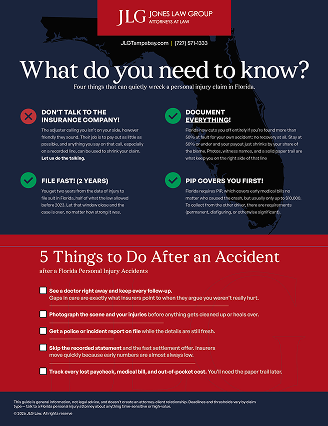
See the things you NEED TO DO after your accident. Get the 5 to-do's sent directly to your email.