JONES LAW GROUPYour Lawyers for Life! Personal Injury Law Firm in St. Petersburg

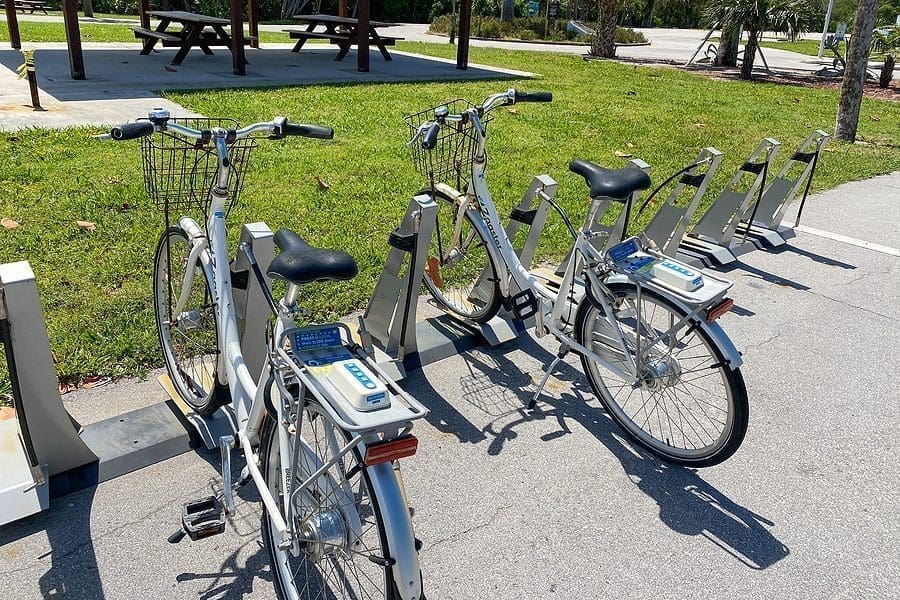
These are the bike safety rules all Florida drivers should know about. Over the last year, cycling has become so popular that retailers are having trouble keeping bicycles in stock. That means there are plenty of novice riders hitting the road, and they’re not all aware of the Florida bicycle laws that will help to […]
Call our personal injury law office directly at (727) 512-9847
At Jones Law Group in St. Petersburg, FL, we would like to hear from you. Contact us for a free personal injury case consultation.
Call our personal injury law office at (727) 512-9847
Get educated on the Florida's personal injury laws and more.
Over the last year, cycling has become so popular that retailers are having trouble keeping bicycles in stock. That means there are plenty of novice riders hitting the road, and they’re not all aware of the Florida bicycle laws that will help to protect them. Even experienced cyclists can benefit from a refresher.
According to Florida law, bicycles are defined as vehicles, and their operators are drivers. This gives cyclists the right to share the roads with much larger cars, trucks, and SUVs. It also means cyclists can be fined, ticketed, and held liable for accidents if they don’t follow the rules of the road. With that said, studies show that motorists are typically at-fault in accidents involving bicycles.
Cyclists who are using the road have to adhere to the same traffic signals that drivers do. That means you must obey stop signs and red lights even when the roads are clear. If you’re riding on the sidewalk, you can follow pedestrian rules instead, such as using the crosswalk when you have the walk signal. While using the sidewalk, you do need to yield to those on foot and alert them when you’re about to pass.
Just as motorists are responsible for maintaining a road-ready vehicle, cyclists have to take similar measures with their bikes. The right brakes are incredibly important when it comes to maneuvering through traffic. A bicycle’s brake system must make a rider capable of stopping the bicycle within 25 feet at a speed of 10 miles per hour on a dry, level, clean pavement.
Florida cyclists are required to meet specific lighting standards if they’re riding between sundown and sunrise. Their bicycles must have two lamps – one on the front and one on the back of the bicycle. The front-facing lamp has to emit white light that is visible from a minimum of 500 feet away. The rear lamp needs to project red light that’s visible from a distance of at least 600 feet. In addition to a lamp, a bike’s rear must have a red reflector with a 600 foot range. The color requirements might sound arbitrary. They’re actually consistent with the colors of vehicle lights. When drivers see a red light or a red reflector, they know the bicycle is traveling in the same direction as they are. An incorrect color on the front or back of a bicycle confuses other travelers. As a result, they might not know whether to slow down, move out of the way, or keep their current pace. It’s a recipe for an accident.
Cyclists have to use their left arm to signal at least 100 feet before a left turn. The signal doesn’t have to be continuous since they need both arms to stay steady. Plan to make a turn from the center of the lane. When the light is green and there is a break in traffic, you can safely make a turn.
To signal a left turn as a cyclist, extend your left arm outward. Similarly, the right hand signal is an extended right arm. It can also be signaled by extending the left arm upward into an L shape. If you need to suddenly slow down or come to a stop, warn other drivers with a downward left arm and hand.
For the most part, cyclists travel at a slower speed than motorists. To maintain the flow of traffic, they should use bicycle lanes when they’re not making a turn. If no bicycle lane is available, Florida cyclists are required to ride as far right as they can practically ride. This increases their visibility to other drivers and leaves space for vehicles to pass on roads that are wide enough. Drivers are required to keep a distance of at least three feet when overtaking a bicycle. Bicyclists are allowed to ride in pairs, but no more than two cyclists can ride side by side on a roadway shared with cars.
It’s crucial to call 911. A dispatcher will get a police officer to the scene as well as an ambulance if necessary. An officer will create a police report that will include any traffic laws the driver may have broken. Officers also often help each party exchange insurance and contact information.
Take photos. Visuals of your injuries, the position and condition of your bicycle, and the surrounding area will substantiate your account of the accident. Photos also demonstrate the extent of the damages you’ve suffered. That can go a long way in increasing the value of your claim.
Speak to witnesses. Their individual reports can show the driver’s negligence. Getting their contact information will make it possible to reach out with follow up questions in the following days or weeks. In some cases, bicycle accident victims are later called to testify in court.
Seek medical attention right away. It’s possible to have injuries that won’t surface immediately. A doctor or nurse might detect a serious problem like a head injury. Additionally, insurance companies question the severity of your injuries if you wait to seek treatment.
Avoid speaking to the other party’s insurance company. Any statements you give them can be misinterpreted and intentionally used against you. Instead, speak to a bicycle accident attorney who can contact them for you and advise you on the best next steps to take.
If you or a loved one has been injured in a bicycle accident due to someone else, speak to an attorney at Jones Law Group. Our attorneys have successfully recovered maximum compensation for many bicycle accident clients. We’ll evaluate your case carefully so that the driver is held accountable for all of your damages. Our initial consultations are always free. Call us at 727-571-1333 or contact us online.
My Child Was in a Car Accident – What Should I do? According to the Centers for Disease Control, there are approximately 150,000 children that are injured each year in traffic accidents.[1] Unfortunately, that estimate is probably understated. What is the reason for the understatement? According to recent studies, small children are more susceptible to […]

By: Heath C. Murphy + – Personal Injury Pedestrian Safety Issues in Largo There have been several highly publicized pedestrian fatalities in Largo in the past year. On November 10, 2014, Sarah Arlia and her two children attempted to cross the road at the intersection of Commerce Drive and Missouri Avenue when they were struck […]

A catastrophic injury is one that has devastating impacts on a person’s life for years. In many cases, the impact may even last a lifetime. It could be due to a car accident, a truck accident, or for a number of other reasons. What makes things even worse is that, in many instances, the victim […]

A slip and fall accident is when someone is injured falling down due to a hazardous condition. It could be a slippery floor, an uneven surface, or an obstruction that is hard to see. In a slip and fall case, a thorough investigation in necessary. The injured party is required to prove through evidence and […]

Lane splitting is the action in which motorcyclists will occupy the space between two cars in order to pass. Lane splitting is often utilized by motorcyclists in stop-and-go traffic and allows them to escape congested areas. Arguments are made that by utilizing lane splitting, motorcyclists are helping to cut down on the amount of pollution […]

By: Heath C. Murphy + – Personal Injury Cars are safer than ever before. Cars are increasingly coming equipped with forward collision warning systems, blind spot detection, lane departure warning, lane departure prevention, autobraking, adaptive headlights and adaptive cruise control. Google is testing driverless technology and expects to have the technology available to automakers by […]
Speak with us before time runs out! In Florida, you have a limited window to file a personal injury case, so speak to an Attorney today.
Call our personal injury law office directly at (727) 512-9847

Jones Law Group is a dedicated personal injury lawyer in St. Petersburg, FL, serving the Tampa Bay area since 2006. Our experienced attorneys specialize in car accidents, slip and fall cases, employment law disputes, construction law issues, and overtime wage claims, fighting for maximum compensation on a contingency fee basis. Contact us for a free consultation to discuss your case.
Call our personal injury law office at (727) 512-9847
© Copyright 2006–2025 Jones Law Group Attorneys at Law. All rights reserved. Privacy Policy Terms of Use
Attorney Advertising.
The information on this website is for general information purposes only. Nothing on this site should be taken as legal advice for any individual case or situation. This information is not intended to create, and receipt or viewing does not constitute, an attorney-client relationship. Past results do not guarantee similar outcomes.
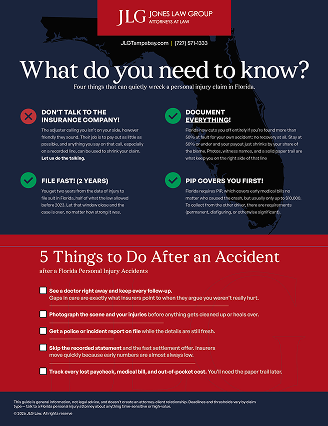
See the things you NEED TO DO after your accident. Get the 5 to-do's sent directly to your email.