JONES LAW GROUPYour Lawyers for Life! Personal Injury Law Firm in St. Petersburg

By: Heath C. Murphy + – Overtime and Wage Claims So your boss has handed you big promotion. He has made you a manager and has agreed to pay you a salary. After awhile you realize that your pay is about the same. You do the same job that you performed prior to the promotion. […]
Call our personal injury law office directly at (727) 512-9847
At Jones Law Group in St. Petersburg, FL, we would like to hear from you. Contact us for a free personal injury case consultation.
Call our personal injury law office at (727) 512-9847
Get educated on the Florida's personal injury laws and more.
By: Heath C. Murphy + – Overtime and Wage Claims
So your boss has handed you big promotion. He has made you a manager and has agreed to pay you a salary. After awhile you realize that your pay is about the same. You do the same job that you performed prior to the promotion. You do not have any real authority on the job. All significant decisions still must be approved by your boss. To add insult to injury, you now are required to work 50 hours per week, but receive no additional pay. Most people assume that since they are salaried and have a job title that they are not entitled to overtime. Nothing could be further from the truth. This determination is dependent upon whether the employee is classified as an exempt or non-exempt employee pursuant The Fair Labor Standards Act.
The Fair Labor Standards Act
The Wage and Hour Division of the U.S. Department of Labor regulates The Fair Labor Standards Act (FLSA) which establishes minimum wage, overtime pay, recordkeeping, and child labor standards that may affect full time and part time workers in private businesses and also State, Federal and local governments. In order to collect overtime wages, you must be a non-exempt employee, meaning you are entitled to receive overtime pay based on your position and duties. White collar jobs and many management positions are considered exempt, but simply because your boss gives you the title of manager and pays you a salary does not necessarily mean you are exempt in the eyes of the law.
Exempt vs. Non-Exempt Employees
Some jobs are classified as exempt by definition. Outside sales employees are non exempt, by definition. While there are grey areas, most employees can be classified as exempt or non-exempt based upon three basic criteria: how much they are paid; how they are paid; and what kind of work they perform. As a general rule, exempt employees must be paid at least $23,600 per year on a salary (not hourly) basis and must perform exempt job duties. Failure to meet any one of the criteria will result in the employee being considered non exempt and eligible to collect overtime wages.
Obviously, the first two criteria can be easily determined. It is the third prong of the test which examines the type of work performed that causes the most trouble. If your job duties include the following abilities and/or duties you will likely be considered an exempt employee.
• Supervising two or more other employees
• Management is the primary duty of the position
• Ability to hire, fire, train, promote and discipline employees
• Ability to set rates of pay
• Ability to set sales goals
• Planning the work
• Apportioning the work among the employees
• Planning budgets
• Monitoring work for safety, legal and regulatory compliance
However, even if your job description seems to qualify as an exempt position you may still qualify for overtime pay if your employer does not treat you as an exempt employee. An example of this would be if your employer “docks” your pay if you miss a day of work. True exempt employees are not docked pay for missing a day of work.
What Happens if My Employer Does Not Pay Me Overtime?
According to FLSA, non-exempt employees must be paid overtime wages at a rate of no less than one and one-half (1 1/2) times their regular rate of pay, after 40 hours of work has been completed within a work week. If your employer does not pay overtime pursuant to the FLSA, you may file a lawsuit. If you can show that you were entitled to overtime, your employer will be liable for your unpaid overtime, liquidated damages in an amount equal to your unpaid overtime and your attorney’s fees.
An employee looking to file a claim for overtime compensation must do so within a specified time period. There is a statute of limitations in the State of Florida for filing such claims. In Florida, you must file your claim within two years of the date which you were entitled to earn the pay. As an employee, you are eligible to recover wages retroactively two (2) years from the date of filing your claim.
Contact an Experienced Wage and Overtime Lawyer at Jones Law Group
Do you believe that your employer has failed to pay you minimum wage and/or overtime? Contact an experienced St. Petersburg wage and overtime attorney at Jones Law Group today. When you contact our office we will immediately set an appointment where you will meet your attorney and be provided with his/her personal contact information. If you do not have transportation or you cannot drive, your attorney will travel to meet you and discuss your case with you.
If your boss is not paying you minimum wage, overtime or requiring you to perform work for periods which you are not being paid, you should immediately call an experienced wage and overtime attorney in St. Petersburg at Jones Law Group at (727) 571-1333 during regular business hours or (727) 753-8657 on weekends or after regular business hours. We will evaluate your case for free and you will never pay us a dime unless we recover compensation for your injuries.
Jones Law Group
5622 Central Avenue
St. Pete, FL 33707
References:

Nearly any kind of personal injury accident can lead to a broken bone. Many people underestimate the impact of a broken or fractured bone (essentially the same thing) on a person’s quality of life. Broken bones happen to thousands of people daily – about 7.6 million people break a bone yearly. If you’ve suffered a […]

Summary When you’re involved in an accident, the aftermath can be overwhelming and stressful. Knowing how to talk to insurance companies effectively to protect your rights and ensure fair compensation for your injuries and damages is crucial. The personal injury attorneys with Jones Law Group would like to share some information on how to talk […]

Summary Personal injury cases can be overwhelming, especially when dealing with the aftermath of an accident. Many accident survivors struggle with the burden of medical bills, lost wages, and other damages. Understanding your rights and options is crucial if you’ve suffered injuries due to a car crash, slip and fall, or another unfortunate incident. The […]

Semi-trucks are vehicles that have the potential to inflict a catastrophic amount of damage should they collide with another vehicle. The sheer size and weight of these vehicles allow them to not only crush cars with ease but also cover the entirety of a road in destruction. This is bad enough but these vehicles are […]

This is one of the first questions many of our clients ask when they choose an attorney with the Jones Law Group to be their legal representative. It’s a very understandable question, of course. People want to know what to expect during the legal process, whether they’ve been hurt in a car accident or they […]

The world has changed greatly because of COVID-19. With the United States in lockdown for months on end and mask mandates required almost everywhere, many people are staying in their homes even past the end of lockdown to prevent themselves (and protect others) from getting COVID-19. 169 million people in the United States have received […]
Speak with us before time runs out! In Florida, you have a limited window to file a personal injury case, so speak to an Attorney today.
Call our personal injury law office directly at (727) 512-9847

Jones Law Group is a dedicated personal injury lawyer in St. Petersburg, FL, serving the Tampa Bay area since 2006. Our experienced attorneys specialize in car accidents, slip and fall cases, employment law disputes, construction law issues, and overtime wage claims, fighting for maximum compensation on a contingency fee basis. Contact us for a free consultation to discuss your case.
Call our personal injury law office at (727) 512-9847
© Copyright 2006–2025 Jones Law Group Attorneys at Law. All rights reserved. Privacy Policy Terms of Use
Attorney Advertising.
The information on this website is for general information purposes only. Nothing on this site should be taken as legal advice for any individual case or situation. This information is not intended to create, and receipt or viewing does not constitute, an attorney-client relationship. Past results do not guarantee similar outcomes.
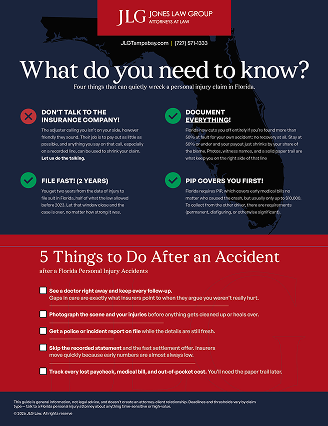
See the things you NEED TO DO after your accident. Get the 5 to-do's sent directly to your email.