JONES LAW GROUPYour Lawyers for Life! Personal Injury Law Firm in St. Petersburg
Reviewed by Bobby Jones, Personal Injury Attorney, Jones Law Group | Published | Updated
Pinellas Park’s flat, gridded streets and its stretch of the Pinellas Trail make it natural e-bike territory, and that includes many older residents in the Mainlands who use electric bikes to stay mobile and independent. But US-19 slices straight through the city, and arterials like Park Boulevard and 49th Street mix e-bikes with fast-moving traffic. When a driver hits a rider, a Pinellas Park e-bike accident lawyer makes sure the insurer treats you as the legitimate road user Florida law says you are. At Jones Law Group, we have recovered more than $50 million for injured clients across Pinellas County and Tampa Bay, and we take electric bike cases on contingency, so you pay nothing unless we win.
An e-bike case has a wrinkle a regular bicycle case does not: sometimes the machine itself is to blame. A battery that catches fire, brakes that fade, or a motor that surges can turn a ride into a crash with no car involved at all, and that opens a second and very different kind of claim.
Since , Fla. Stat. § 316.20655 has classified electric bicycles as bicycles, not motor vehicles. That single choice carries real weight for an injured rider. You need no driver’s license, no registration, and no insurance to ride one legally. You have the same right to the road, the same three-foot passing protection under Fla. Stat. § 316.083, and the same access to bike lanes and most trails as any cyclist. When an insurer hints that your e-bike made you something other than a cyclist, or suggests you needed a license, that is simply wrong on the law, and we make the adjuster answer to the statute.
The law sorts e-bikes into three classes by how their motor assists and how fast that assist goes. The distinction matters more than most riders realize, because the fastest class changes how a crash gets argued.
What makes an electric bike claim different from an ordinary bicycle claim is that it can run on two tracks at once.
The driver who hit you. Most e-bike crashes are still car-versus-rider collisions, and here your case looks like any serious cycling claim: you pursue the at-fault driver’s liability coverage, backed by PIP and your own uninsured motorist coverage. More on that below.
The e-bike itself. Electric bikes carry powerful lithium-ion batteries, motors, controllers, and braking systems, and when one of those fails the result can be catastrophic with no car anywhere near. A battery that overheats or catches fire, a throttle that sticks, a motor that surges unexpectedly, or brakes that fade at speed can throw a rider hard. When the machine caused the crash, Florida product liability law lets you pursue the manufacturer, distributor, or retailer that put a defective product into your hands. Those claims involve preserving the bike as evidence, engineering analysis, and a completely different set of defendants and insurance, and they are easy to miss if a lawyer treats your case as a garden-variety bike crash. We look at both fronts from day one.
Did your e-bike catch fire or fail before the crash? Do not throw it out or send it back to the seller. It is evidence. Call (727) 571-1333 for a free consultation first.
Most e-bike riders assume their only recourse is the driver’s insurance. In Florida, a rider struck by a motor vehicle is generally entitled to PIP benefits, the same as a traditional cyclist. If you own a car with a Florida policy, your own PIP pays your first $10,000 in medical bills and lost wages. If you do not own a car, a resident relative’s policy may cover you, and if there is none, the PIP of the driver who hit you applies.
Two things to remember. First, the 14-day rule: you must get initial medical treatment within 14 days of the crash or the PIP benefit is lost. Second, PIP is only the floor. Because a body meeting a bumper produces serious injuries, you can usually step past PIP and pursue the at-fault driver directly for the full measure of your damages, including pain and suffering. Here is where the Class 3 wrinkle appears: a bike that assists to 28 mph closes distance faster than a driver expects, and insurers use that to argue the rider was going “too fast” and shift blame under comparative negligence. We counter it with the bike’s own ride data, the physical evidence, and the driver’s duty to look.
In Pinellas Park the danger is defined by one road: US-19 runs straight through the city, an elevated, high-speed corridor that riders must navigate around. Beyond it, the Pinellas Trail and its street crossings carry the heaviest e-bike volume, while Park Boulevard, 49th Street North, 66th Street North, and 4th Street North mix bikes with steady traffic, and the Gateway business area near the St. Petersburg line adds constant commercial vehicles. We use Pinellas crash data from Forward Pinellas to show how a specific crossing or intersection behaves, which matters when a driver claims the rider came out of nowhere.
Pinellas Park has no hospital of its own, so injured e-bike riders are usually taken to Northside Hospital or St. Petersburg General just to the south, or HCA Florida Largo to the west, with the county’s most severe trauma routed to Orlando Health Bayfront Hospital in St. Petersburg, the only Level II trauma center in Pinellas County. Those treatment records become the backbone of your damages case, and we know how to obtain and present them. A Pinellas Park e-bike lawsuit is filed with the Sixth Judicial Circuit at the Pinellas County courthouse in downtown Clearwater.
Each pattern raises its own evidence and fault questions.
A driver turns right across a rider in a bike lane, or turns left across an oncoming e-bike. Speed misjudgment is common here, and the class-3 argument often follows.
A parked driver opens a door into the lane, or a passing driver drifts into a rider they never checked for. The e-bike’s speed is not the cause; the failure to look is.
Where the Pinellas Trail meets a road, drivers scan for cars and miss faster-moving e-bikes. These crossings produce some of the area’s worst rider injuries.
A defective battery fire, a sticking throttle, a motor surge, or brake failure can cause a crash with no vehicle involved, pointing the claim at the manufacturer or seller.
When a driver flees, your own uninsured motorist coverage may pay, and PIP still covers initial bills. The crash report is essential to both.
Has the driver’s insurer already blamed your e-bike’s speed? That is a tactic, not a verdict. Call (727) 571-1333 for a free case review before you respond.
Value depends on your injuries, the fault evidence, and the insurance or product coverage available, so no lawyer can promise a number. Florida splits damages into two categories. Economic damages cover medical bills, future care, lost wages, reduced earning capacity, and the e-bike itself, which for a quality electric bike is often a multi-thousand-dollar loss on its own. Non-economic damages cover pain and suffering, mental anguish, scarring, and loss of enjoyment of life.
Florida’s modified comparative negligence rule reduces your recovery by your share of fault and bars it entirely above 50%, which is exactly why insurers press the speed argument so hard against e-bike riders. A product-liability claim, where it applies, can add an entirely separate layer of coverage. For more on how value is calculated, see our guide on how much a Florida injury settlement is worth and our two-year deadline guide. Because e-bike and bicycle crashes share a legal foundation, our Pinellas Park bicycle accident lawyer page covers the underlying cycling rules in more depth.
Jones Law Group is led by attorney Bobby Jones, a U.S. Air Force veteran and Stetson Law graduate with more than 20 years of personal injury practice in Tampa Bay. We have recovered over $50 million for injured clients and hold a 4.9 rating on Google. We know the statutes that protect e-bike riders, the trail crossings and arterials where these crashes happen, and the product-liability path when the machine itself failed, and we file at the Pinellas County courthouse in downtown Clearwater when an insurer will not be fair. We work on contingency, so we only get paid when you do. See everything we handle on our Pinellas Park personal injury lawyer page.
No. Under Florida Statute § 316.20655, e-bikes are treated like bicycles, so no driver’s license, registration, or insurance is required to ride one. You have the same road rights and duties as any cyclist, and an insurer that claims otherwise is wrong on the law.
Generally yes. An e-bike rider struck by a motor vehicle can claim PIP benefits through their own auto policy, a resident relative’s policy, or the at-fault driver’s PIP if neither exists. You must get initial medical treatment within 14 days of the crash to keep the benefit.
Possibly a strong one. If a defective battery, motor, controller, or braking system caused your crash, Florida product liability law lets you pursue the manufacturer, distributor, or retailer. Preserve the e-bike and do not return it to the seller, because it is the central evidence in that kind of claim.
Usually yes. Riding a Class 3 e-bike at its assisted speed is legal, and speed alone is not fault. Insurers raise it to inflate your share of blame under comparative negligence, but the driver’s duty to look and yield does not disappear because you were moving at a lawful speed. Ride data and physical evidence often rebut the argument.
Only riders and passengers under 16 are legally required to wear a helmet, the same rule that applies to regular bicycles. An adult riding without one has broken no law, and while an insurer may raise it regarding a head injury, it has no bearing on your other injuries.
Jones Law Group works on a contingency fee: no up-front cost, no hourly bill, and a fee only if we recover money for you. The initial consultation is free.
Whether a driver hit you or your e-bike failed underneath you, Florida law gives you more protection than any insurance company will volunteer. Tell us what happened in a free consultation, with no obligation and no fee unless we win.
Jones Law GroupDisclaimer: This page is for general information only and is not legal advice. Reading it does not create an attorney-client relationship. Every case is different, and prior results do not guarantee a similar outcome. The $50 million figure reflects total amounts recovered for clients over time, not a promise about any individual case. If you have a specific legal question, contact a licensed Florida attorney.
Speak with us before time runs out! In Florida, you have a limited window to file a personal injury case, so speak to an Attorney today.
Call our personal injury law office directly at (727) 512-9847

Jones Law Group is a dedicated personal injury lawyer in St. Petersburg, FL, serving the Tampa Bay area since 2006. Our experienced attorneys specialize in car accidents, slip and fall cases, employment law disputes, construction law issues, and overtime wage claims, fighting for maximum compensation on a contingency fee basis. Contact us for a free consultation to discuss your case.
Call our personal injury law office at (727) 512-9847
© Copyright 2006–2025 Jones Law Group Attorneys at Law. All rights reserved. Privacy Policy Terms of Use
Attorney Advertising.
The information on this website is for general information purposes only. Nothing on this site should be taken as legal advice for any individual case or situation. This information is not intended to create, and receipt or viewing does not constitute, an attorney-client relationship. Past results do not guarantee similar outcomes.
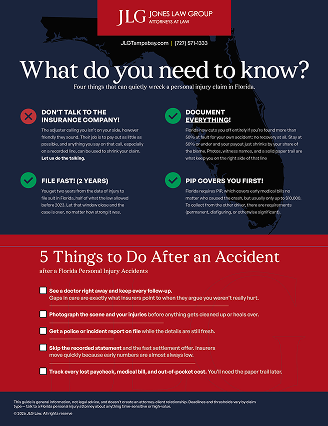
See the things you NEED TO DO after your accident. Get the 5 to-do's sent directly to your email.
