JONES LAW GROUPYour Lawyers for Life! Personal Injury Law Firm in St. Petersburg
Reviewed by Bobby Jones, Personal Injury Attorney, Jones Law Group | Published | Updated
An Uber or Lyft crash in Largo starts an argument you never agreed to join. The driver’s personal insurer says the rideshare policy applies. The rideshare insurer says the personal policy applies. And while the two of them point fingers, your medical bills arrive on schedule. The entire argument turns on one fact: what the driver was doing in the app at the moment of impact. A Largo rideshare accident lawyer nails that fact down and holds the right insurer to it. At Jones Law Group, we have recovered more than $50 million for injured clients across Pinellas County and Tampa Bay, and we take rideshare cases on contingency, so you pay nothing unless we win.
Whether you were the passenger, another driver, a cyclist, or a pedestrian, the framework below decides whose policy pays, and how much is on the table.
Under Fla. Stat. § 627.748, Florida’s transportation network company law, the insurance available in a rideshare crash depends entirely on the driver’s app status when it happened.
Phase zero: app off. The driver is a private motorist, and only their personal auto policy applies. The complication is that many personal policies exclude commercial driving, so any dispute about whether the app was on is worth real money.
Phase one: app on, waiting for a request. The law requires at least $50,000 per person and $100,000 per crash in bodily injury liability, plus $25,000 for property damage. This is the murky middle where insurers fight hardest, because the driver was working but had no passenger.
Phases two and three: en route to a pickup, or carrying a passenger. This is where the big policy lives: $1 million in liability coverage, required by statute and carried by both Uber and Lyft. Uninsured motorist protection may also apply during a trip, which matters when the at-fault party is a third driver with minimal coverage.
The app data settles which phase applied, down to the second. Getting that data preserved and produced is one of the first things we do in every rideshare case.
The cleanest cases belong to passengers. If you were riding in the Uber or Lyft, you were in phase three, the $1 million policy was active, and you were not at fault by definition. Fault fights between the rideshare driver and another driver do not change your right to recover; they only change which insurer pays.
If you were the driver or passenger of another car, a cyclist, or a pedestrian hit by a rideshare vehicle, your recovery depends on the phase. A distracted Uber driver staring at the app between rides is a phase-one claim. One heading to a pickup is a phase-two claim against the $1 million policy. Remember too that Florida’s no-fault rules still run underneath all of this: your own PIP pays first, and only if you seek treatment within 14 days.
And if you were the rideshare driver hurt by someone else’s negligence, you have a claim against the at-fault driver, plus possible coverage through the rideshare policy depending on your phase and your own endorsements. Those cases are messier, and worth a conversation.
Getting calls from two or three different insurance companies? Do not give any of them a recorded statement. Call (727) 571-1333 and let us sort out who actually owes you.
Three reasons. First, the finger-pointing is structural: every insurer in the chain saves money by pushing the claim to a different phase, and an unrepresented victim has no way to force the app data into the open. Second, Uber and Lyft classify drivers as independent contractors, which the companies use to keep themselves out of the case; the claim runs against the insurance stack, and the stack pays only what it is made to pay. Third, the evidence is unusual: trip logs, GPS pings, and in-app messages, none of which the companies hand over voluntarily. We send preservation demands early so none of it quietly disappears.
Largo’s rideshare traffic runs on its main corridors and its errands: rides along Ulmerton Road and US-19, trips to and from the restaurants and bars on East Bay Drive and Seminole Boulevard, medical and shopping runs across the city, and the constant airport traffic up Ulmerton toward the Courtney Campbell Causeway and Tampa International. Out-of-town drivers watching a navigation screen, late-night trips, and heavy arterial traffic combine into predictable crash patterns, and we use Pinellas crash data from Forward Pinellas to support fault arguments at specific spots. Seriously injured victims are treated at Largo Medical Center, or at Orlando Health Bayfront Hospital in St. Petersburg, the county’s only Level II trauma center, for the worst injuries.
Value depends on your injuries, the fault evidence, and which policy phase applies, so no lawyer can promise a number. Florida splits damages into economic damages, your medical bills, future care, lost wages, and lost earning capacity, and non-economic damages, your pain and suffering, mental anguish, and loss of enjoyment of life. The unusual feature of rideshare cases is the ceiling: a claim that a typical driver’s small policy would cap may have $1 million of coverage behind it if the phase is right, which is why establishing the phase is worth the fight.
Florida’s modified comparative negligence rule reduces recovery by your share of fault and bars it above 50%, though for passengers that is rarely an issue. For more on valuation, see our guide on how much a Florida injury settlement is worth and our two-year deadline guide. Rideshare crashes are ultimately car crashes with extra layers, so our Largo car accident lawyer page covers the underlying rules in more depth.
Not sure which phase your crash falls into? Send us the basics and we will tell you, free. Call (727) 571-1333.
Jones Law Group is led by attorney Bobby Jones, a U.S. Air Force veteran and Stetson Law graduate with more than 20 years of personal injury practice in Tampa Bay. We have recovered over $50 million for injured clients and hold a 4.9 rating on Google. Rideshare cases reward a firm that pins down the app data early and refuses to let insurers pass the claim around, and that is how we run them, ready to file at the Pinellas County courthouse in downtown Clearwater if an insurer will not deal fairly. We work on contingency, so we only get paid when you do. See everything we handle on our Largo personal injury lawyer page.
Yes. During a trip, Florida law requires the rideshare company to carry $1 million in liability coverage, and as a passenger you have a claim regardless of whether your driver or another driver caused the crash. The fault fight between drivers only determines which insurer pays you.
Then the crash is treated like an ordinary car accident and the driver’s personal auto policy applies. If the app status is disputed, the trip data resolves it, which is one reason to involve a lawyer who can demand that data before it becomes hard to get.
Usually the claim runs against the insurance coverage the companies are required to carry, rather than the companies themselves, because Florida law treats rideshare drivers as independent contractors. In practice that coverage, up to $1 million during a trip, is where compensation comes from, and pursuing it correctly is what matters.
From the moment a driver accepts a ride request until the passenger exits the vehicle, under Florida Statute § 627.748. If the driver was logged in but waiting for a request, lower limits of $50,000 per person and $100,000 per crash apply instead.
You generally have two years from the date of the crash to file a lawsuit, under Florida Statute § 95.11 as amended by HB 837 in 2023. Trip data, dashcam footage, and witness memories fade much sooner, so start early. You must also seek medical treatment within 14 days to preserve PIP benefits.
Jones Law Group works on a contingency fee: no up-front cost, no hourly bill, and a fee only if we recover money for you. The initial consultation is free.
Three insurers, one injured person, and a coverage question worth up to $1 million: that is not a fight to take on alone. Tell us what happened in a free consultation, with no obligation and no fee unless we win.
Jones Law GroupDisclaimer: This page is for general information only and is not legal advice. Reading it does not create an attorney-client relationship. Every case is different, and prior results do not guarantee a similar outcome. The $50 million figure reflects total amounts recovered for clients over time, not a promise about any individual case. If you have a specific legal question, contact a licensed Florida attorney.
Speak with us before time runs out! In Florida, you have a limited window to file a personal injury case, so speak to an Attorney today.
Call our personal injury law office directly at (727) 512-9847

Jones Law Group is a dedicated personal injury lawyer in St. Petersburg, FL, serving the Tampa Bay area since 2006. Our experienced attorneys specialize in car accidents, slip and fall cases, employment law disputes, construction law issues, and overtime wage claims, fighting for maximum compensation on a contingency fee basis. Contact us for a free consultation to discuss your case.
Call our personal injury law office at (727) 512-9847
© Copyright 2006–2025 Jones Law Group Attorneys at Law. All rights reserved. Privacy Policy Terms of Use
Attorney Advertising.
The information on this website is for general information purposes only. Nothing on this site should be taken as legal advice for any individual case or situation. This information is not intended to create, and receipt or viewing does not constitute, an attorney-client relationship. Past results do not guarantee similar outcomes.
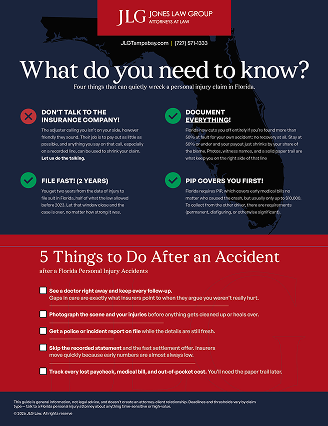
See the things you NEED TO DO after your accident. Get the 5 to-do's sent directly to your email.
