JONES LAW GROUPYour Lawyers for Life! Personal Injury Law Firm in St. Petersburg
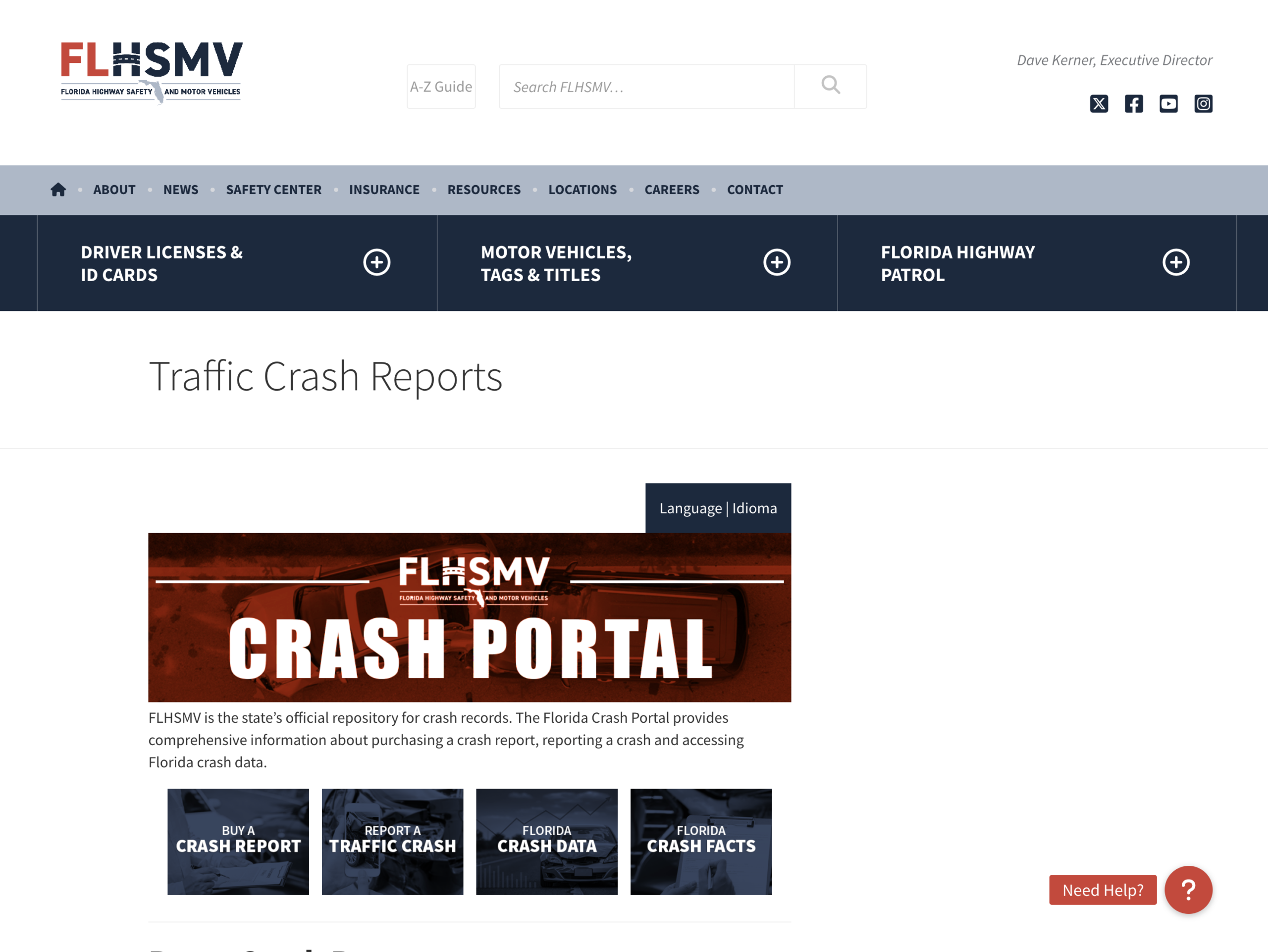
The Florida crash report (HSMV 90010S) is where every injury case starts, but it’s also the most confusing document most crash victims will ever try to read. This guide breaks down Long Form vs. Short Form, how to get your report from the FLHSMV Crash Portal, the 60-day confidentiality rule under § 316.066(2)(b), and what every section actually tells you — including the contributing cause codes, injury classifications, and narrative details that decide how your claim gets built.
Call our personal injury law office directly at (727) 512-9847
At Jones Law Group in St. Petersburg, FL, we would like to hear from you. Contact us for a free personal injury case consultation.
Call our personal injury law office at (727) 512-9847
Get educated on the Florida's personal injury laws and more.
By Bobby Jones, Esq. | Published
A Florida crash report is the official HSMV 90010S form completed by the law enforcement officer who responded to your accident. It comes in two versions — Long Form (with a narrative and diagram) and Short Form — and contains the crash date and location, the drivers and vehicles involved, insurance information, injury classifications, contributing causes, and the officer’s narrative. You can obtain your report through the Florida Crash Report Portal at flhsmv.gov for $10 per copy, but under Florida Statute § 316.066(2)(b), most requesters must wait 60 days from the crash date before the report becomes publicly available. Involved drivers, their attorneys, and insurers can access reports sooner with proper eligibility documentation.
This guide walks through what the report contains, how to obtain one, section by section how to read it, and what the report tells you (and what it does not) about fault and case value. If you were injured in a Florida crash and want help interpreting your report, call Bobby Jones at (727) 571-1333 for a free consultation. No fee unless we win.
A Florida Traffic Crash Report is the standardized form (HSMV 90010S) that Florida law enforcement officers complete when they respond to a reportable traffic crash. The report becomes the official record of the accident and is transmitted to the Florida Department of Highway Safety and Motor Vehicles, where it becomes accessible through the FLHSMV Crash Portal.
Under Florida Statute § 316.066, a crash must be reported to law enforcement immediately when it involves:
For crashes that do not meet reporting thresholds and where no officer responded, drivers can self-file using form HSMV 90011S (Driver Self Report of Traffic Crash). Self-filed reports carry less evidentiary weight than officer-completed reports, but they are better than no record at all.
Both forms use the same base document (HSMV 90010S). The difference is whether the officer completed the full narrative and diagram sections.
A Long Form report includes the officer’s narrative description of the crash and a diagram of the scene. The Long Form is required when the crash:
If you were injured in a Florida crash, your report is almost certainly a Long Form. The narrative and diagram sections are where the officer’s understanding of what happened is documented, and they are often the most useful part of the report for an injury claim.
The Short Form is used for reportable crashes that do not meet the Long Form criteria — typically low-damage, no-injury property damage crashes. Short Form reports contain the basic crash information but omit the narrative and diagram.
You have several ways to request your crash report. The most common:
Since , the FLHSMV Crash Portal at flhsmv.gov has offered online crash report purchases. The fee is $10 per report under Florida Statute § 321.23, with a limit of 10 reports per transaction. To request a report, you will need:
Requests for 10 or fewer crash records can be fulfilled at the FHP Troop Station nearest to where the crash occurred, if your case involves an FHP-investigated accident.
For crashes investigated by St. Petersburg Police Department, Pinellas County Sheriff’s Office, Clearwater Police, or other local agencies, you can request the report directly from that agency during the initial period before it transmits to FLHSMV. Local agency procedures vary; most now direct requesters to the state portal after a short window.
Services like LexisNexis, CrashDocs, and myaccident.org can retrieve Florida crash reports on your behalf, usually for a fee above the state’s $10. Attorneys typically use these services for volume access.
One detail that catches many crash victims by surprise: under Florida Statute § 316.066(2)(b), most Florida crash reports are confidential for the first 60 days after the crash. During that window, only specific eligible parties can access the report:
The rule was tightened by Senate Bill 1614 in to reduce solicitation of crash victims by attorneys, chiropractors, and other services who used to buy new crash reports in bulk to pitch services.
To access a report within the 60-day window, an eligible requester must submit a Sworn Statement to Obtain Crash Report (form HSMV 94010) attesting to their eligibility and providing driver’s license or other identifying information. Attorneys typically handle this on behalf of injured clients.
Need your report faster than 60 days? Jones Law Group can pull it for you as your attorney. Call (727) 571-1333.
The Florida crash report is a dense document. Here is what each major section contains and what to look for.
The top of the report lists the crash date, time, reporting agency, agency case number, and HSMV crash report number. Verify these match your recollection. Errors here can create administrative headaches later.
This section identifies where the crash happened. Look for:
Environmental conditions matter for liability arguments. A rain-slick crash on I-275 is a different case than a dry-pavement crash at the same location.
Each vehicle involved gets its own section, numbered sequentially. Look for:
Each person involved gets a numbered entry. This includes drivers, passengers, pedestrians, and cyclists. Look for:
Officers classify each injured person on a scale set by federal reporting standards:
The classification affects PIP eligibility, subsequent evidence value, and case building. An “O” classification on someone who later develops severe symptoms is problematic. If you had any pain at the scene, insist the officer document it, even if you feel it is minor.
The officer assigns one or more contributing cause codes to each driver, indicating what the officer believes contributed to the crash. Common codes include:
Contributing cause codes are the officer’s opinion based on the scene evidence and statements. They are not a legal fault determination. But they carry weight with insurance adjusters and, if the case goes to trial, can be introduced as evidence.
On Long Form reports, the officer writes a narrative describing what happened based on witness statements, physical evidence, and the officer’s investigation. Read this section carefully.
Look for:
Narratives are written from the officer’s perspective and can contain errors, omissions, or misinterpretations. If you find factual mistakes, document them and discuss them with an attorney.
The diagram shows the crash scene as the officer understood it: vehicle positions before, during, and after the collision; direction of travel; roadway features; and impact points.
Diagrams are visual summaries, not scaled reconstructions. They can be wrong. Compare the diagram to your recollection and to any photographs you have from the scene.
A Florida crash report is powerful evidence, but it has real limits.
Under Florida Statute § 316.066(4), statements made to the investigating officer for the purpose of the crash report may be inadmissible in later civil proceedings (this is the accident report privilege). But the objective facts in the report — locations, vehicle information, insurance, witness identification — remain valuable.
The crash report is often the first document a Florida injury attorney reviews. From it, an experienced practitioner extracts:
The report is also the starting point for identifying what evidence still needs to be gathered: photos of the scene, dashcam video, phone records, medical records tying injuries to the crash, and expert witness needs.
Officers do their best under difficult conditions, but errors happen. Watch for:
If you find significant errors, discuss them with an attorney. Amending an official report is difficult, but the client’s version of events can be documented separately and used in negotiations and litigation.
Most Pinellas County crash reports are filed by St. Petersburg Police Department, Pinellas County Sheriff’s Office, Clearwater Police Department, or the Florida Highway Patrol depending on the location. Interstate crashes on I-275 and I-4 are typically FHP jurisdiction. Reports transmit to the FLHSMV Crash Portal within a few days of completion. Local agencies can sometimes provide a redacted copy sooner for eligible parties.
Bobby Jones is a Stetson Law graduate, an Air Force veteran, and has practiced personal injury law in Tampa Bay for more than 20 years. Jones Law Group has recovered more than $50 million for clients. Our office at 5622 Central Avenue, St. Petersburg, FL 33707 handles injury cases arising from crashes throughout Pinellas County, Tampa, Clearwater, Largo, and across Florida. We review crash reports as the first step of every case.
The official Florida crash report is HSMV 90010S, maintained by the Florida Department of Highway Safety and Motor Vehicles. It is used by all Florida law enforcement agencies to report traffic crashes. Both Long Form (with narrative and diagram) and Short Form use the same base form number.
Under Florida Statute § 316.066(2)(b), most requesters must wait 60 days from the crash date to obtain a report. Involved parties, their attorneys, and their insurance companies can access reports sooner by submitting a Sworn Statement to Obtain Crash Report (HSMV 94010). Officers typically submit their reports within a few days of the crash.
The state fee is $10 per report under Florida Statute § 321.23, purchased through the FLHSMV Crash Portal at flhsmv.gov. Third-party services may charge additional fees on top of the state cost.
No. The crash report contains the officer’s contemporaneous assessment of fault, but the report is evidence, not a legal verdict. Insurance companies, judges, and juries can reach different conclusions about fault. Contributing cause codes on the report carry weight but are not binding.
Drivers can self-file using form HSMV 90011S (Driver Self Report of Traffic Crash) online or by mail. Self-filed reports carry less evidentiary weight than officer-completed reports, but they establish an official record of the crash and are better than no report at all.
Amending an official crash report is difficult and often not possible after the initial submission window. If you find significant factual errors, document them in writing and discuss them with an attorney. Your version of events can be recorded separately for use in negotiations and litigation.
Through the FLHSMV Crash Portal at flhsmv.gov, you can search by crash date and county plus one of: driver last name, crash report number, or driver’s license number of an involved party.
Under Florida’s accident report privilege at § 316.066(4), statements made to the investigating officer for the purpose of completing the crash report may be inadmissible in later civil proceedings. This is a narrow rule with important limits. Consult an attorney about how the privilege applies to your specific statements.
For a minor property-damage crash with clear liability, you may be able to handle the claim yourself. For any case involving injuries, disputed fault, multiple defendants, commercial vehicles, or significant damages, an experienced Florida personal injury attorney will pull far more information out of the report than a layperson can. Most Florida injury attorneys, including Jones Law Group, work on contingency, so consultations cost nothing.
The crash report is where every Florida injury case starts, but reading it correctly takes practice. What looks like a straightforward rear-end collision on the report can turn out to involve a commercial vehicle, an employer defendant, and an insurance stack worth many times what the individual driver carries.
If you were injured in a Florida crash and want a straight read on what your report actually shows, Bobby Jones and the team at Jones Law Group can help. The consultation is free, and there is no fee unless we win.
Call (727) 571-1333 or email [email protected].
This article is for general informational purposes only and is not legal advice. Florida crash reporting requirements are set by statute and may change through legislation or agency rulemaking. Verify current requirements with the Florida Department of Highway Safety and Motor Vehicles or a licensed Florida attorney. Reading this article does not create an attorney-client relationship with Jones Law Group. Every case is different, and past results do not guarantee a similar outcome in any future case.

Motorcycle accidents can have devastating consequences, causing severe injuries and leaving a lasting impact on the lives of those involved. These accidents often result in physical and mental disabilities, affecting the victim’s quality of life, financial stability, and overall well-being. The following is a closer look at just some of these terrible impacts. The attorneys […]

Florida has nearly twice the amount of coastline as any other state in the continental U.S.[1] Pinellas County, alone, has 35 miles of beaches and many miles more of coastline. Additionally, pools are a very common feature of homes in St. Petersburg, Clearwater and Tampa. All of these things sound wonderful, but it also makes […]

By: Heath C. Murphy + – Personal Injury I have blogged about the dangers of suffering a head injury and the cognitive and emotional impairments that can be caused by head injuries, however new studies indicate a link between head injuries and early onset dementia. Some of the more common causes of traumatic brain injuries […]

The major benefits of having car insurance include being able to access timely compensation for medical bills, lost wages, and vehicle repairs in the event of an auto accident. Summary On average, Floridians pay $3,183 a year for car insurance. This is roughly 37% more than the national annual coverage. This can be contributed to […]

By: Heath C. Murphy + – Personal Injury Yesterday, I wrote an article about food poisoning. The article took a much more clinical approach than what I originally set out to write. However, it is extremely important to any food poisoning case that the individual pathogen be identified. Today, I will look at a food […]
Recent drinking and driving statistics reveal patterns among the perpetrators and circumstances of drunk driving accidents, and demonstrate the devastating impact driving under the influence can have. Summary Driving under the influence is among the most common causes of auto accidents in the United States of America. It poses a significant threat to safety with […]
Speak with us before time runs out! In Florida, you have a limited window to file a personal injury case, so speak to an Attorney today.
Call our personal injury law office directly at (727) 512-9847

Jones Law Group is a dedicated personal injury lawyer in St. Petersburg, FL, serving the Tampa Bay area since 2006. Our experienced attorneys specialize in car accidents, slip and fall cases, employment law disputes, construction law issues, and overtime wage claims, fighting for maximum compensation on a contingency fee basis. Contact us for a free consultation to discuss your case.
Call our personal injury law office at (727) 512-9847
© Copyright 2006–2025 Jones Law Group Attorneys at Law. All rights reserved. Privacy Policy Terms of Use
Attorney Advertising.
The information on this website is for general information purposes only. Nothing on this site should be taken as legal advice for any individual case or situation. This information is not intended to create, and receipt or viewing does not constitute, an attorney-client relationship. Past results do not guarantee similar outcomes.
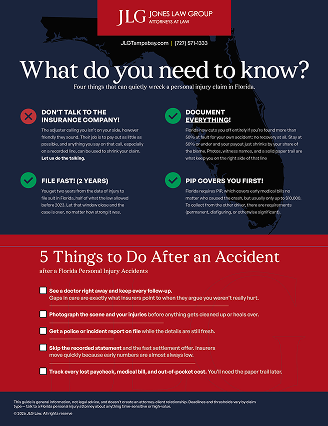
See the things you NEED TO DO after your accident. Get the 5 to-do's sent directly to your email.