JONES LAW GROUPYour Lawyers for Life! Personal Injury Law Firm in St. Petersburg
Reviewed by Bobby Jones, Personal Injury Attorney, Jones Law Group | Published June 22, 2026 | Updated June 22, 2026
You slipped on a wet floor at a store, hit the ground hard, and now you are hurt and out of work. It feels open and shut: their floor, their fault. Florida law does not see it that way. Slip and fall cases are some of the hardest injury claims to win in this state, because the law puts the burden on you to prove the business knew about the hazard. A St. Petersburg slip and fall lawyer who understands that burden is the difference between a paid claim and a denied one. At Jones Law Group, we have recovered more than $50 million for injured clients across Tampa Bay, and we take these cases on contingency, so you pay nothing unless we win.
We build slip and fall claims from our office on Central Avenue, in the county where you were hurt, and we move fast to lock down the one thing these cases live or die on: evidence that the business should have caught the danger and did not.
The hurdle is Florida Statute § 768.0755. If you slip on a transitory foreign substance, meaning a temporary hazard like a spill, a tracked-in puddle, or dropped produce in a business, you have to prove the business had knowledge of it. Just showing that you fell is not enough.
Knowledge comes in two forms. Actual knowledge means an employee knew the spill was there. Constructive knowledge means the hazard existed long enough that the business should have found and fixed it, or that it happened so regularly the business should have expected it. Proving constructive knowledge usually comes down to time: how long was that puddle on the floor before you stepped in it? That is why surveillance footage and cleanup logs matter so much, and why a quick lowball denial from the store is not the last word.
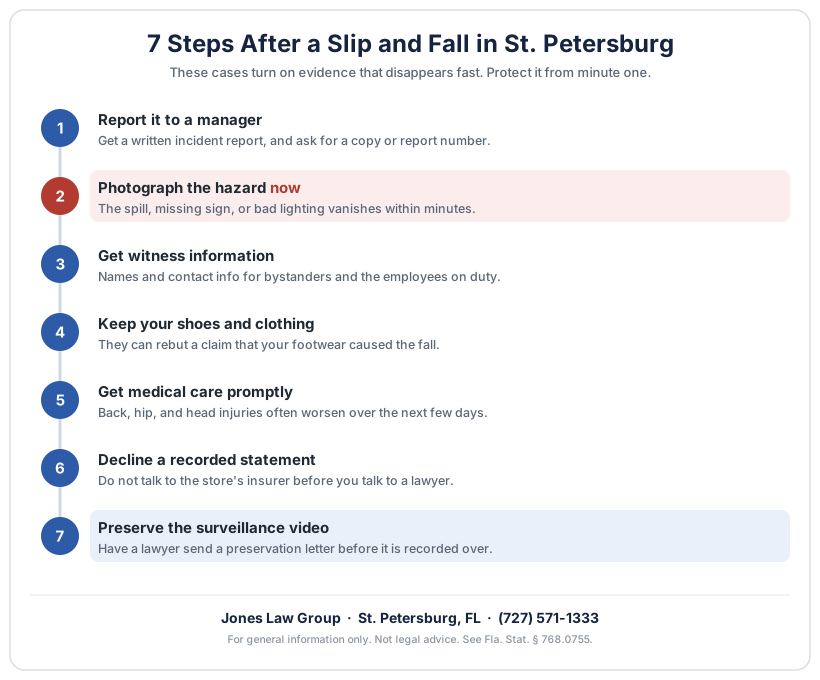
What you do in the first few minutes shapes whether you can ever prove that notice element. Follow these steps.
For more detail, see our guide on the steps to take after a slip and fall at a Florida business.
Worried the store already deleted the footage? The sooner we send a preservation letter, the better. Call (727) 571-1333 for a free consultation.
Pinellas County is dense with the kinds of businesses where these falls occur. Grocery stores like the Publix locations across St. Pete generate spill and produce-floor cases. Big-box retailers, restaurants, and bars add wet floors and poor lighting. Our heavy tourism means hotels and resorts with slick pool decks and lobby floors. And apartment complexes, parking lots, and parking garages produce falls from broken pavement, missing handrails, and unlit stairwells. Each setting has its own maintenance records and its own way of trying to avoid the blame.
Slip and fall is one branch of premises liability, the body of law that holds property owners responsible for keeping their property reasonably safe. These are the cases we handle most for St. Pete clients.
The classic case: a spill, a leak, or a freshly mopped floor with no warning sign. The fight is almost always over how long the hazard was there.
Cracked tile, torn carpet, unmarked steps, and transitions between surfaces cause falls that the property owner often knew about for months.
Dim stairwells, missing handrails, and code violations turn an ordinary set of stairs into a hazard, especially in apartments and parking garages.
In warehouse-style stores, poorly stacked or overloaded shelving sends merchandise down onto customers, a premises case that does not involve a fall at all.
Potholes, wheel stops, oil slicks, and broken curbs in lots and garages are some of the most common and most disputed premises claims.
Not sure the business will admit anything? They rarely do. That is our job. Call (727) 571-1333 for a free case review.
No lawyer can promise a number, because value depends on your injuries, the strength of the notice evidence, and the available insurance. Florida sorts damages into two categories. Economic damages cover medical bills, future care, lost wages, and reduced earning capacity. Non-economic damages cover pain and suffering, mental anguish, and loss of enjoyment of life.
One factor weighs especially heavy in slip and fall cases: your own share of fault. Florida uses modified comparative negligence, so if the business argues the hazard was open and obvious or that you were distracted, it can reduce your recovery, and bar it entirely if you are found more than 50% at fault. For a fuller breakdown, see our guide on average slip and fall settlements in Florida and our two-year deadline guide.
Jones Law Group is led by attorney Bobby Jones, a U.S. Air Force veteran and Stetson Law graduate who has practiced personal injury law in Tampa Bay for more than 20 years. We have recovered over $50 million for injured clients and hold a 4.9 rating on Google. Because slip and fall cases turn on evidence that disappears, we move quickly to preserve video and records, and because we work on contingency, we only get paid when you do. See the full range of cases we handle on our St. Petersburg personal injury lawyer page.
Under Florida Statute § 768.0755, you must prove the business had actual or constructive knowledge of the dangerous condition and failed to fix it. Constructive knowledge usually means showing the hazard existed long enough that the business should have found it, or that it happened regularly enough to be foreseeable.
They are harder than most people expect, because the law requires proof that the business knew or should have known about the hazard. Simply falling and getting hurt is not enough. Strong cases are built on evidence like surveillance video, incident reports, and witness accounts, which is why acting quickly matters.
You may still have a case, but it is harder. Go back and report it in writing as soon as possible, gather any photos or witness information you have, and talk to a lawyer quickly so surveillance footage can be preserved before it is erased.
Often yes. Florida uses modified comparative negligence, which reduces your recovery by your share of fault and bars it only if you are found more than 50% responsible. A business will often argue the danger was open and obvious, so how fault is framed matters a great deal.
You generally have two years from the date of the fall to file a lawsuit, under Florida Statute § 95.11 as amended by HB 837 in 2023. Because the key evidence fades fast, it is best to act well before that deadline.
Jones Law Group works on a contingency fee, with no up-front cost and no hourly bill. We only collect a fee if we recover money for you, and the initial consultation is free.
If you were hurt by a hazard a business should have fixed, do not let a quick denial be the end of it. Tell us what happened in a free consultation, with no obligation and no fee unless we win.Jones Law Group
5622 Central Avenue, St. Petersburg, FL 33707
Phone: (727) 571-1333
Email: [email protected]
Disclaimer: This page is for general information only and is not legal advice. Reading it does not create an attorney-client relationship. Every case is different, and prior results do not guarantee a similar outcome. The $50 million figure reflects total amounts recovered for clients over time, not a promise about any individual case. If you have a specific legal question, contact a licensed Florida attorney.
Speak with us before time runs out! In Florida, you have a limited window to file a personal injury case, so speak to an Attorney today.
Call our personal injury law office directly at (727) 512-9847

Jones Law Group is a dedicated personal injury lawyer in St. Petersburg, FL, serving the Tampa Bay area since 2006. Our experienced attorneys specialize in car accidents, slip and fall cases, employment law disputes, construction law issues, and overtime wage claims, fighting for maximum compensation on a contingency fee basis. Contact us for a free consultation to discuss your case.
Call our personal injury law office at (727) 512-9847
© Copyright 2006–2025 Jones Law Group Attorneys at Law. All rights reserved. Privacy Policy Terms of Use
Attorney Advertising.
The information on this website is for general information purposes only. Nothing on this site should be taken as legal advice for any individual case or situation. This information is not intended to create, and receipt or viewing does not constitute, an attorney-client relationship. Past results do not guarantee similar outcomes.
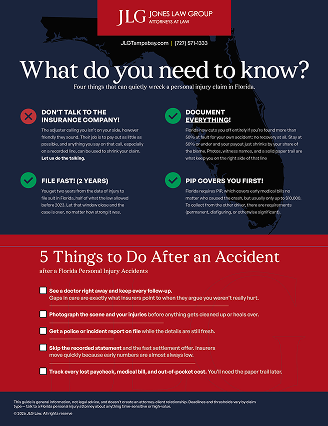
See the things you NEED TO DO after your accident. Get the 5 to-do's sent directly to your email.
