JONES LAW GROUPYour Lawyers for Life! Personal Injury Law Firm in St. Petersburg
Reviewed by Bobby Jones, Personal Injury Attorney, Jones Law Group | Published | Updated
Losing a family member because of someone else’s negligence is one of the hardest things a person can go through, and it often arrives alongside a list of legal questions no one should have to sort out alone. A Sarasota wrongful death lawyer at Jones Law Group can carry those questions for your family — who is allowed to bring a claim, what the law says your family may recover, and how much time you have — while you focus on each other. We work on contingency, so there is no fee unless we recover compensation for your family, and the initial consultation is always free and confidential.
Florida’s wrongful death laws are more specific, and in some ways more counterintuitive, than most families expect. Not every grieving relative can file suit, the damages available to the estate are legally distinct from the damages available to surviving family members, and the filing deadline is measured from a date that isn’t always obvious. Understanding these rules early can matter a great deal to what a family is ultimately able to recover.
Under the Florida Wrongful Death Act, Fla. Stat. §§ 768.16–768.26, a wrongful death claim can only be filed by the decedent’s personal representative — the individual formally appointed by a probate court to act on behalf of the deceased person’s estate. This is often, but not always, a surviving spouse or adult child, and if no personal representative has yet been appointed, that step typically needs to happen before a lawsuit can move forward. This surprises many Sarasota families, who assume that a spouse or parent can simply sue on their own behalf.
The personal representative doesn’t keep any recovery personally. Instead, the lawsuit is brought for the benefit of the estate and for a defined group of survivors — generally the decedent’s spouse, minor children, and, in some circumstances, adult children, parents, or other blood relatives and adoptive siblings who were partly or wholly dependent on the decedent for support or services. Each survivor’s relationship to the decedent affects which damages they may be entitled to receive, which is why an early, accurate accounting of the family’s circumstances matters.
Florida law separates a wrongful death claim into two distinct buckets of damages, and understanding the difference matters because different family members may be entitled to different amounts. Survivors’ damages belong to the qualifying family members themselves — a surviving spouse may recover for lost companionship and protection as well as mental pain and suffering; minor children (and, in the case of a deceased minor, sometimes parents) may recover for lost parental companionship, guidance, and instruction; and dependents who relied on the decedent may recover for lost support and services, plus medical or funeral expenses they personally paid.
Estate’s damages, by contrast, belong to the decedent’s estate and are pursued by the personal representative for the benefit of the estate as a whole. These typically include the decedent’s lost earnings and lost net accumulations from the date of injury to the date of death, earnings the decedent likely would have earned in the future had they lived, and medical or funeral expenses paid by the estate rather than by an individual family member. Because these categories are calculated differently and paid to different people, a careful accounting early in the case helps make sure no survivor’s loss is overlooked.
Wrongful death claims in Sarasota County come from a range of circumstances, and no two families’ situations look alike. Some follow serious crashes on corridors like US-41/Tamiami Trail, I-75, or US-301, or at busy roundabouts such as those on Gulfstream Avenue or at Jacaranda Boulevard and East Venice Avenue — locations where a moment of inattention or an unsafe turn can have lasting consequences. Others arise from unsafe conditions on someone else’s property, or from a failure to provide an acceptable standard of medical care.
When a serious injury occurs, patients throughout Sarasota County are often stabilized at ER facilities such as HCA Florida Sarasota Doctors Hospital on Bee Ridge Road, or brought to Sarasota Memorial Hospital, the county’s only Level II Trauma Center verified by the American College of Surgeons. In some cases, a loved one survives for days, weeks, or longer before ultimately passing — a timeline that, as explained below, matters a great deal for when the legal deadline to file actually begins.
If your family is grieving a loss you believe was preventable, you don’t have to figure out the legal side on your own. Jones Law Group offers a free, confidential consultation with no obligation. Call (727) 571-1333 whenever you’re ready to talk.
Florida generally gives a personal representative two years to file a wrongful death lawsuit under Fla. Stat. § 95.11. What surprises many families is that this clock starts on the date of death — not the date of the crash, fall, or medical event that ultimately caused it. If a loved one survives an accident for a period of time before passing away, the two-year window is measured from when they died, which can be considerably later than the incident itself.
This distinction can matter significantly. A family whose loved one was injured in one year and passed away well over a year later is not necessarily out of time — the wrongful death deadline is separate from, and runs independently of, any deadline that would have applied to a personal injury claim the decedent could have brought had they survived. Because these deadlines and their exceptions are fact-specific, it’s worth having a Sarasota wrongful death lawyer confirm the applicable date as soon as possible, since missing the deadline generally bars the claim entirely.
There is no fixed dollar figure for a wrongful death claim, because the value depends on the survivors involved, the decedent’s income and life circumstances, and the strength of the evidence establishing fault. In broad terms, value is built from the survivors’ damages and the estate’s damages described above — lost companionship and guidance, lost support and services, funeral and medical expenses, and the decedent’s lost future earnings and accumulations.
Florida’s modified comparative negligence statute, Fla. Stat. § 768.81, can also affect recovery. If the decedent is found partly responsible for the incident that led to their death, the family’s recovery may be reduced by that percentage of fault, and current Florida law bars recovery entirely if the decedent is found more than 50% at fault. These same comparative-fault principles apply broadly across Florida injury claims — for a deeper look at how compensation is calculated more generally, see our guide to how much a Florida injury settlement is worth, and for more on filing deadlines, our two-year deadline guide explains how Florida’s statute of limitations works in related injury cases.
Every family’s situation is different. The only way to get a realistic sense of your case’s value is to have it reviewed. Reach Jones Law Group at (727) 571-1333 for a free, no-pressure conversation.
Attorney Bobby Jones leads Jones Law Group’s approach to wrongful death cases with a focus on patience and clarity — helping families understand the legal process at a pace that respects what they’re going through, while working diligently in the background to protect their rights and their deadlines. The firm has helped clients recover more than $50M in cumulative compensation and maintains a 4.9-star client rating, though we recognize that no amount can replace what a family has lost; our goal is simply to make sure the people responsible are held accountable and that your family isn’t left carrying the financial burden as well.
Jones Law Group represents Sarasota families on a contingency-fee basis, meaning there is no upfront cost and no fee unless we recover compensation. For a broader look at how we help injured clients and families throughout the area, visit our Sarasota personal injury lawyer page.
The questions below cover some of the most common concerns Sarasota families raise after losing a loved one. If your situation involves something not addressed here, we’re glad to talk it through directly.
Only the decedent’s court-appointed personal representative may file a Florida wrongful death lawsuit. This person is typically named in the decedent’s will or appointed by a probate court, and they bring the claim on behalf of the estate and the decedent’s qualifying survivors, such as a spouse, minor children, or dependents, rather than in their own individual name.
Survivors’ damages belong to qualifying family members, such as a spouse or minor children, and cover losses like companionship, guidance, mental pain and suffering, and support they relied on. Estate’s damages belong to the decedent’s estate and generally cover the decedent’s lost future earnings, lost net accumulations, and medical or funeral expenses the estate paid. Florida law treats these as separate categories with different recipients.
The two-year deadline under Florida Statute Section 95.11 runs from the date of death, not the date of the underlying accident or injury. This matters when a loved one survives their injuries for a period of time before passing away, since the clock does not begin until they have died.
The wrongful death filing deadline is still measured from the date of death, even if that date is well after the original accident or injury. Because the timeline can involve overlapping medical and legal considerations, it’s worth having an attorney confirm the applicable deadline as soon as possible after a loss.
It can. Under Florida’s modified comparative negligence law, Florida Statute Section 768.81, if the decedent is found partly at fault for the incident, the family’s recovery may be reduced by that percentage, and recovery is barred entirely if the decedent is found more than 50 percent at fault. An attorney can help evaluate how fault is likely to be allocated in your specific case.
Jones Law Group represents wrongful death families on a contingency-fee basis, meaning there is no upfront cost to hire us and no attorney fee unless we recover compensation on your family’s behalf. The initial consultation is free and confidential.
Wrongful death civil lawsuits arising in Sarasota County are filed in the Twelfth Judicial Circuit at the Judge Lynn N. Silvertooth Judicial Center, located at 2002 Ringling Blvd, Sarasota, FL 34237.
If your family is navigating the loss of someone you love, you don’t need to face the legal questions alone. Jones Law Group is here to listen, answer your questions honestly, and, when you’re ready, help your family pursue the accountability and compensation the law allows. Contact us whenever the time feels right — there’s no cost to talk, and no obligation to move forward.
Jones Law GroupThis page is for general informational purposes only and does not constitute legal advice. Reading this page or contacting Jones Law Group does not create an attorney-client relationship. Past results, including any reference to $50M+ in recoveries, are cumulative figures from prior cases and do not guarantee or predict a similar outcome in any future case.
Speak with us before time runs out! In Florida, you have a limited window to file a personal injury case, so speak to an Attorney today.
Call our personal injury law office directly at (727) 512-9847

Jones Law Group is a dedicated personal injury lawyer in St. Petersburg, FL, serving the Tampa Bay area since 2006. Our experienced attorneys specialize in car accidents, slip and fall cases, employment law disputes, construction law issues, and overtime wage claims, fighting for maximum compensation on a contingency fee basis. Contact us for a free consultation to discuss your case.
Call our personal injury law office at (727) 512-9847
© Copyright 2006–2025 Jones Law Group Attorneys at Law. All rights reserved. Privacy Policy Terms of Use
Attorney Advertising.
The information on this website is for general information purposes only. Nothing on this site should be taken as legal advice for any individual case or situation. This information is not intended to create, and receipt or viewing does not constitute, an attorney-client relationship. Past results do not guarantee similar outcomes.
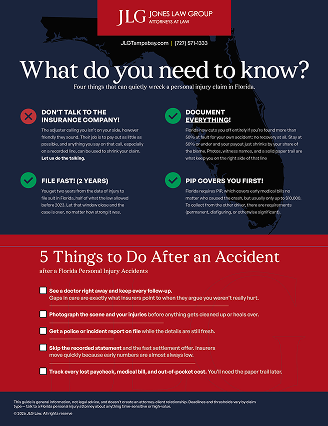
See the things you NEED TO DO after your accident. Get the 5 to-do's sent directly to your email.
