JONES LAW GROUPYour Lawyers for Life! Personal Injury Law Firm in St. Petersburg
Reviewed by Bobby Jones, Personal Injury Attorney, Jones Law Group | Published | Updated
Losing a family member because of someone else’s negligence is a loss no legal process can undo, and the last thing a grieving family should have to manage alone is a set of unfamiliar legal rules. If your loved one died in a crash near the I-275/I-4 interchange, a fall on someone else’s property, a case of medical negligence, or another preventable event in the Tampa Bay area, a Tampa wrongful death lawyer can help you understand what Florida law allows and carry that burden so your family doesn’t have to face it while grieving. Attorney Bobby Jones has represented Tampa Bay families for years, and Jones Law Group has recovered more than $50M+ (a cumulative figure across all prior cases; individual results vary) on behalf of clients. We work on contingency, so there is no fee unless we recover compensation for your family.
Florida’s wrongful death law is more specific, and in some ways more counterintuitive, than most families expect. It controls exactly who is legally permitted to bring a claim, what categories of loss can be recovered, and — importantly — when the filing clock actually starts running. Understanding these rules early, rather than after a deadline has quietly passed, is often the difference between a family being able to seek accountability and losing that opportunity altogether.
Under the Florida Wrongful Death Act, Fla. Stat. §§ 768.16–768.26, only one person may formally bring a wrongful death lawsuit: the decedent’s personal representative, a person appointed by the probate court to act on behalf of the estate. This surprises many families, who understandably assume a spouse, adult child, or parent can file directly. Instead, that person, often a spouse or adult child but sometimes another qualified individual, must first be appointed by the court, and then files the claim on behalf of both the estate and the family members who are legally entitled to recover.
The people on whose behalf the personal representative may seek damages are called survivors, and Florida defines this group specifically. Survivors typically include the decedent’s spouse, children, and parents. In certain circumstances, other blood relatives or adoptive siblings who were partly or wholly dependent on the decedent for support or services may also qualify. Not everyone who loved and misses the person who died has a legal right to recover damages personally — the statute draws a defined line, and getting that determination right at the outset matters for how the case proceeds.
Florida law separates wrongful death damages into two distinct categories, and the distinction matters both legally and practically. Survivors’ damages belong to the qualifying family members personally — a surviving spouse may recover for loss of companionship, protection, and the value of the decedent’s services; minor children may recover for loss of parental companionship, instruction, and guidance, in addition to their own mental pain and suffering; and each survivor who paid medical or funeral expenses on the decedent’s behalf may recover those costs directly.
Estate’s damages, by contrast, belong to the decedent’s estate rather than to any individual family member. These typically include the decedent’s lost earnings between the date of injury and the date of death, the loss of prospective net accumulations the decedent would likely have earned over a normal life expectancy, and medical or funeral expenses paid by the estate rather than by a family member personally. Because these two categories are calculated and awarded separately, an accurate wrongful death claim requires sorting out early which losses belong to which category, and to which specific survivor.
Wrongful death claims in the Tampa Bay area arise from a range of circumstances, though roadway crashes are among the most common. High-volume interchanges and corridors such as the I-275/I-4 interchange downtown, the Selmon Expressway, Dale Mabry Highway, Hillsborough Avenue near Sheldon Road, Fowler Avenue and Bruce B. Downs Boulevard near the University of South Florida, and the US-301 corridor through Gibsonton and Big Bend Road each carry heavy, fast-moving traffic that can turn a moment’s inattention into a fatal outcome. Other wrongful death claims arise from falls on unsafe property, medical negligence, and other situations where a person or business failed to act with reasonable care. When a person is injured and survives for a period of time before passing, the case can also involve a combination of injury claims and wrongful death claims that require careful sequencing.
When these cases reach a Tampa hospital, the region’s trauma centers, Tampa General Hospital on Davis Islands, Tampa Bay’s only Level I trauma center for both adult and pediatric patients, and St. Joseph’s Hospital, a BayCare Level II trauma center, generate detailed medical records that later help establish both the cause and timeline of a loved one’s injuries and passing. Preserving those records, along with police reports, witness accounts, and other evidence, early in the process helps protect a family’s ability to hold the responsible party accountable.
If your family is navigating a loss caused by someone else’s negligence, you don’t have to sort through Florida’s filing rules on your own. Call Jones Law Group at (727) 571-1333 whenever you’re ready to talk, in confidence and at no cost.
Florida’s statute of limitations for wrongful death claims, set out in Fla. Stat. § 95.11, generally gives a family two years to file suit. What often catches families off guard is when that two-year period begins: it runs from the date of death, not the date of the accident or injury that ultimately caused it. This distinction matters most in cases where a loved one was injured and survived for days, weeks, or even longer before passing. A family in that situation may have already been pursuing, or considering, a personal injury claim on the decedent’s behalf, and that claim’s separate two-year clock, tied to the date of the injury, does not control the wrongful death deadline. The wrongful death clock starts fresh on the date of death.
Because the personal representative must be formally appointed by the probate court before a wrongful death suit can be filed, and because that appointment process itself takes time, families are generally better served by starting the process well before the two-year mark rather than waiting until it approaches. Missing the deadline generally bars the claim entirely, regardless of how clear the underlying negligence may be.
There is no fixed dollar figure for a wrongful death claim, and no attorney can promise a specific outcome. What can be said is that the value of a claim depends on the combination of survivors’ damages and the estate’s damages described above: the decedent’s age, earning capacity, and life expectancy; the number and relationship of qualifying survivors; the medical and funeral expenses actually incurred; and the strength of the evidence establishing fault. Florida’s modified comparative negligence rule also still applies in wrongful death cases, meaning that if the decedent is found partly at fault for the circumstances that led to the fatal event, the family’s total recovery can be reduced by that percentage. For background on how Florida calculates injury and settlement values more generally, see our guide on how much a Florida injury settlement is worth, and our two-year deadline guide for more on how Florida’s filing deadlines work across different types of claims.
If you have questions about what your family’s claim may involve, call (727) 571-1333 to speak with our team, quietly and without obligation.
Attorney Bobby Jones has spent his career representing injured people and grieving families throughout Tampa Bay, and Jones Law Group has recovered more than $50M+ (cumulative results across all prior cases, not a prediction of any future outcome) on their behalf. The firm holds a 4.9 average client rating, built on years of direct, patient communication with families during some of the hardest periods of their lives. We understand that a wrongful death case is never just a legal file, and we handle each one with the discretion and care it deserves. Our firm works entirely on contingency, so a grieving family is never asked to pay upfront costs, and we’re only paid if we recover compensation. To learn more about how we handle injury and negligence claims across the region, visit our Tampa personal injury lawyer page.
Below are answers to the questions Tampa families most often ask about wrongful death claims in Florida.
Only the decedent’s personal representative may file a wrongful death lawsuit under Fla. Stat. §§ 768.16-768.26. This is a person formally appointed by the probate court, often a spouse or adult child, who then brings the claim on behalf of both the estate and the family members legally entitled to recover, called survivors.
The personal representative is appointed through Florida’s probate court process, typically in the county where the decedent lived. If the decedent left a will naming an executor, that person is often appointed personal representative; if not, the court appoints someone, usually a close family member, based on Florida’s priority rules. An attorney can help guide a family through this appointment before the wrongful death claim is filed.
It runs from the date of death, not the date of the underlying accident or injury, under Fla. Stat. § 95.11. This matters most when a loved one survived for a period of time after being injured before passing away, since the wrongful death filing clock starts fresh on the date of death rather than on the date of the original incident.
Florida separates damages into two categories: survivors’ damages, which belong personally to a spouse, children, or other qualifying survivors and can include loss of companionship, guidance, and support; and the estate’s damages, which can include the decedent’s lost future earnings and medical or funeral expenses paid by the estate. Both categories are pursued together by the personal representative.
Survivors typically include the decedent’s spouse, children, and parents. In some circumstances, other blood relatives or adoptive siblings who were partly or wholly dependent on the decedent for support or services may also qualify as survivors entitled to recover damages.
Wrongful death lawsuits arising in Hillsborough County are filed at the George E. Edgecomb Courthouse, 800 E. Twiggs Street, Tampa, FL 33602, which serves the Thirteenth Judicial Circuit of Florida.
Jones Law Group handles wrongful death claims on a contingency fee basis, so families pay no upfront legal fees and owe nothing unless we recover compensation on their behalf. Case costs are typically advanced by the firm and resolved from any eventual settlement or verdict.
If your family has lost someone because of another person’s or company’s negligence, you don’t have to figure out Florida’s filing rules while you’re still grieving. Call Jones Law Group at (727) 571-1333 for a free, confidential consultation. We’ll listen to what happened, explain your family’s options clearly and without pressure, and let you know how we can help, all at no cost to you.
Whenever you’re ready to talk, our Tampa wrongful death team is available at (727) 571-1333 for a free, no-obligation conversation.
This page is for general informational purposes only and does not constitute legal advice. Reading this page or contacting Jones Law Group does not create an attorney-client relationship. Past results, including any reference to $50M+ in recoveries, are cumulative figures from prior cases and do not guarantee or predict a similar outcome in any future case.
Speak with us before time runs out! In Florida, you have a limited window to file a personal injury case, so speak to an Attorney today.
Call our personal injury law office directly at (727) 512-9847

Jones Law Group is a dedicated personal injury lawyer in St. Petersburg, FL, serving the Tampa Bay area since 2006. Our experienced attorneys specialize in car accidents, slip and fall cases, employment law disputes, construction law issues, and overtime wage claims, fighting for maximum compensation on a contingency fee basis. Contact us for a free consultation to discuss your case.
Call our personal injury law office at (727) 512-9847
© Copyright 2006–2025 Jones Law Group Attorneys at Law. All rights reserved. Privacy Policy Terms of Use
Attorney Advertising.
The information on this website is for general information purposes only. Nothing on this site should be taken as legal advice for any individual case or situation. This information is not intended to create, and receipt or viewing does not constitute, an attorney-client relationship. Past results do not guarantee similar outcomes.
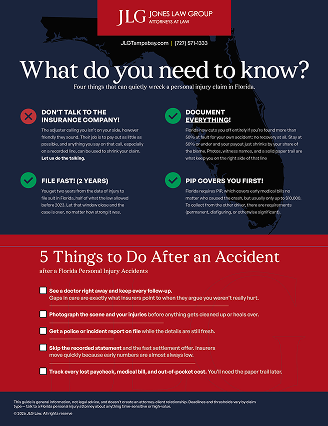
See the things you NEED TO DO after your accident. Get the 5 to-do's sent directly to your email.
