JONES LAW GROUPYour Lawyers for Life! Personal Injury Law Firm in St. Petersburg
Reviewed by Bobby Jones, Personal Injury Attorney, Jones Law Group | Published | Updated
Every day, thousands of Uber and Lyft rides start or end along International Drive, at the theme park resort pickup queues, and at the curbside lanes of Orlando International Airport (MCO). With that volume comes crashes — vehicles cutting across three lanes of I-Drive traffic to reach a pickup pin, drivers staring at a phone screen instead of the road, and rideshare cars stopped in travel lanes because there was nowhere else to pull over. If one of those crashes left you hurt, an Orlando rideshare accident lawyer can help you sort out who actually owes you money — because with a TNC crash, that answer is almost never simple. Jones Law Group has spent years untangling these claims for injured passengers, drivers, and pedestrians across Central Florida, and we work on a contingency fee basis, so you owe us nothing unless we recover for you.
What makes a rideshare claim different from an ordinary car accident case is the insurance puzzle sitting underneath it. Uber and Lyft do not simply hand over a $1 million policy every time one of their drivers crashes. Florida law ties the available coverage to what the driver’s app was doing at the exact moment of impact, and insurance companies are well aware that most injured people do not know how to prove that. Sorting out the driver’s app status — whether the app was off, on and waiting, en route to a pickup, or actively carrying a passenger — is usually the first and most contested question in any Orlando rideshare case.
Every Uber and Lyft trip in Florida moves through a sequence of insurance “phases” defined by Fla. Stat. § 627.748, Florida’s Transportation Network Company law. The coverage available to an injured passenger, another driver, or a pedestrian depends entirely on which phase the rideshare driver was in when the wheels actually collided — not on when the ride was booked, and not on what the driver tells the responding officer after the fact.
Period 0 — app off. The driver has not logged into the Uber or Lyft app, or has logged out. If this driver causes a crash, Uber’s and Lyft’s insurance does not apply at all. Only the driver’s personal auto policy is available, and many personal policies carry minimum Florida limits or exclude commercial activity outright.
Period 1 — app on, waiting for a ride request. The driver is logged in and available but has not yet been matched with a passenger. Florida law requires TNCs to carry contingent liability coverage during this window, typically around $50,000 per person for bodily injury, $100,000 per incident, and $25,000 in property damage. This coverage is “contingent,” meaning it generally only pays after the driver’s personal policy is exhausted or if that policy denies the claim.
Periods 2 and 3 — en route to pickup and passenger on board. Once the driver accepts a ride request and begins driving toward the passenger (Period 2), and continuing through the entire trip until the passenger exits the vehicle (Period 3), Uber and Lyft are each required to provide up to $1 million in commercial liability coverage. This is the coverage tier that matters most for passengers, and it also protects other drivers and pedestrians the rideshare vehicle hits during these phases.
The practical problem is that rideshare companies and their insurers do not hand over trip data voluntarily. Establishing exactly which period applied at the moment of your crash usually requires formal legal requests for the driver’s trip log, app status records, and GPS timestamps — documentation an Orlando rideshare accident lawyer knows how to demand and how to read.
Orlando’s rideshare crash patterns track the city’s tourism and nightlife geography. Along International Drive and the surrounding theme park resort corridor, Uber and Lyft drivers are constantly pulling to the curb, stopping in travel lanes, and making sudden U-turns to reach a pickup pin outside a hotel, water park, or restaurant. That volume of stop-and-go traffic, mixed with distracted out-of-town pedestrians and drivers glued to a rider-matching app, produces a steady stream of rear-end collisions, sideswipes, and pedestrian strikes.
Orlando International Airport (MCO) is one of the busiest rideshare pickup hubs in the state, and the designated TNC pickup zones there create their own hazards — vehicles merging quickly across lanes, drivers searching for the right waiting spot, and heavy congestion during peak arrival windows. Downtown Orlando’s bar and restaurant district near Church Street Station and Lake Eola generates a different kind of risk: late-night rideshare pickups involving impaired other drivers, poor visibility, and drivers who have been on shift for hours and are pushing through fatigue to fit in one more fare.
Beyond the tourist and nightlife zones, a large share of Orlando rideshare crashes happen on the roads that connect them — the I-4 corridor, SR 50/Colonial Drive, and Orange Blossom Trail (OBT). These are high-speed, high-volume routes where a driver checking a phone for turn-by-turn directions or a new ride request has little margin for error, and a moment’s distraction can mean a serious collision.
Your role in the crash shapes both your claim and the insurance analysis. If you were a passenger in the Uber or Lyft when it crashed, the driver was necessarily in Period 3, so the $1 million commercial policy is generally in play regardless of who caused the wreck — though the at-fault party still needs to be identified, and a second vehicle’s insurer may share responsibility.
If you were driving another car and a rideshare vehicle hit you, the phase question becomes central: a rideshare driver rushing to a pickup pin (Period 2) or already carrying a fare (Period 3) exposes the $1 million policy, while one still cruising for a match (Period 1) leaves you looking at a much smaller pool of coverage, and one who had logged off the app (Period 0) leaves only their personal policy.
Pedestrians struck near I-Drive hotel entrances, MCO curbside lanes, or downtown Orlando crosswalks face the same analysis. Rideshare drivers looking for a pickup spot or making an abrupt stop are a recurring cause of pedestrian strikes in these areas, and identifying the driver’s app status at impact is just as critical to a pedestrian’s claim as it is to a passenger’s or another motorist’s.
Hurt in an Uber or Lyft crash in Orlando? Jones Law Group can pull the trip data and insurance information your claim needs. Call (727) 571-1333 for a free, no-obligation consultation — you pay nothing unless we win.
Rideshare crashes on I-Drive, near MCO, and along I-4 or Colonial Drive frequently happen at highway speed or involve pedestrians struck by a vehicle, and the injuries reflect that: traumatic brain injuries, spinal cord damage, internal bleeding, fractures, and severe soft-tissue trauma are common. Orlando Regional Medical Center (ORMC) is Central Florida’s only verified Level I Trauma Center for adults, and it is where the most critically injured rideshare crash victims from across the Orlando area are typically taken by EMS. Adjacent Arnold Palmer Hospital handles pediatric trauma cases, which matters for families whose children were riding along or were struck as pedestrians near a hotel or attraction pickup zone.
Consistent, documented treatment at facilities like these does more than address your medical needs — it builds the medical record that supports your claim. Insurance adjusters look closely for gaps in treatment or delayed care as a reason to undervalue an injury claim, so following through on referrals, imaging, and follow-up appointments matters as much for your case as for your recovery.
There is no fixed dollar figure that applies to every Orlando rideshare accident claim. Value depends on the severity of your injuries, the length and cost of your treatment, lost income, and the strength of the coverage available once the app-status phase is established. Depending on the facts, a claim can include compensation for past and future medical bills, lost wages and diminished earning capacity, property damage, and pain and suffering.
Florida is a comparative negligence state, so if you were partly at fault — for example, a pedestrian who stepped into a rideshare pickup lane, or a passenger who wasn’t wearing a seatbelt — your recovery can be reduced by your share of fault, though it does not automatically bar your claim. For a deeper look at how these factors combine, see our guide on how much a Florida injury settlement is worth. And because Florida’s filing deadline is unforgiving, review our two-year deadline guide as soon as possible after your crash so you don’t lose your right to recover before you’ve even had a chance to evaluate your claim.
Not sure what your Orlando rideshare claim is worth? Reach out to Jones Law Group at (727) 571-1333 or [email protected] for a free case evaluation.
Bobby Jones has built his practice around representing people hurt in Florida car, motorcycle, and rideshare crashes, and he understands the specific insurance mechanics that TNC companies rely on to limit payouts. Jones Law Group has recovered more than $50 million for injured clients across Florida and holds a 4.9-star client rating, built by walking clients through exactly what to expect at each stage of a claim — from requesting rideshare trip logs to negotiating with Uber’s and Lyft’s insurers to, when necessary, filing suit in the Ninth Judicial Circuit.
We handle Orlando rideshare accident claims on a contingency fee basis, so there’s no upfront cost to find out where you stand. If you’re looking for broader help with a Central Florida injury claim beyond a rideshare crash, our Orlando personal injury lawyer page covers the full range of cases we handle in the area.
If the driver was logged into the app and available but had not yet accepted a ride, Florida’s contingent liability coverage under Fla. Stat. § 627.748 applies, typically providing around $50,000 per person, $100,000 per incident, and $25,000 in property damage. This coverage generally fills gaps after the driver’s personal policy, rather than replacing it outright.
No. The $1 million commercial liability policy only applies during Periods 2 and 3 — when the driver is en route to pick up a passenger or has a passenger in the vehicle. If the driver’s app was off or the driver was merely logged in without an accepted ride, a much smaller policy or only the driver’s personal auto insurance applies.
Yes. Pedestrians struck by an Uber or Lyft vehicle near I-Drive hotels, theme park resort pickup areas, or downtown Orlando can pursue a claim against the driver and, depending on the driver’s app status at the time, against Uber’s or Lyft’s insurance coverage as well.
Florida law generally gives you two years from the date of the crash to file a personal injury lawsuit under Fla. Stat. § 95.11. Rideshare cases often take time to investigate because of the app-status coverage dispute, so it’s best to start the process well before that deadline approaches.
If the at-fault driver’s available coverage doesn’t fully cover your damages, your own uninsured/underinsured motorist coverage, if you have it, may apply. An Orlando rideshare accident lawyer can identify every source of coverage available in your specific situation.
Fault is determined the same way as in any Florida car accident, using police reports, witness statements, traffic camera footage, and vehicle data. Florida’s comparative negligence rule means your recovery can be reduced by your percentage of fault, but you can still recover even if you were partially responsible.
No. Jones Law Group reviews Orlando rideshare accident cases on a contingency fee basis, meaning there is no upfront cost for a consultation and no fee unless we recover compensation for you.
If you were hurt as a passenger, another driver, or a pedestrian in an Orlando rideshare crash — whether it happened along International Drive, near MCO, downtown, or on I-4, Colonial Drive, or OBT — Jones Law Group is ready to review your case. We’ll identify the driver’s app status, pursue the correct insurance policy, and handle the claim from start to finish so you can focus on recovering. Call, email, or reach out online today for a free consultation.
Jones Law GroupThis page is for general informational purposes only and does not constitute legal advice. Reading this page or contacting Jones Law Group does not create an attorney-client relationship. Past results, including any reference to $50M+ in recoveries, are cumulative figures from prior cases and do not guarantee or predict a similar outcome in any future case.
Speak with us before time runs out! In Florida, you have a limited window to file a personal injury case, so speak to an Attorney today.
Call our personal injury law office directly at (727) 512-9847

Jones Law Group is a dedicated personal injury lawyer in St. Petersburg, FL, serving the Tampa Bay area since 2006. Our experienced attorneys specialize in car accidents, slip and fall cases, employment law disputes, construction law issues, and overtime wage claims, fighting for maximum compensation on a contingency fee basis. Contact us for a free consultation to discuss your case.
Call our personal injury law office at (727) 512-9847
© Copyright 2006–2025 Jones Law Group Attorneys at Law. All rights reserved. Privacy Policy Terms of Use
Attorney Advertising.
The information on this website is for general information purposes only. Nothing on this site should be taken as legal advice for any individual case or situation. This information is not intended to create, and receipt or viewing does not constitute, an attorney-client relationship. Past results do not guarantee similar outcomes.
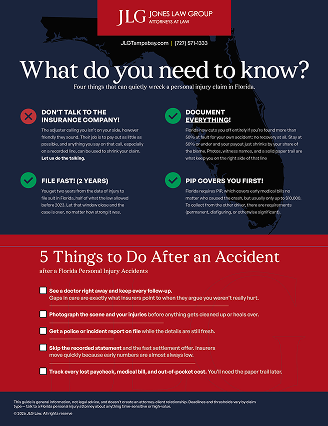
See the things you NEED TO DO after your accident. Get the 5 to-do's sent directly to your email.
