JONES LAW GROUPYour Lawyers for Life! Personal Injury Law Firm in St. Petersburg
Reviewed by Bobby Jones, Personal Injury Attorney, Jones Law Group | Published | Updated
On a Friday night at St. Armands Circle, the valet lines back up, the sidewalks fill with dinner crowds moving between restaurants, and a steady stream of Uber and Lyft drivers circle the roundabout looking for their next pickup. The same scene plays out in Siesta Key Village, where a single narrow grid of bars and restaurants funnels rideshare traffic in and out all night long. That volume of app-directed driving, mixed with distracted phone-checking and tourists unfamiliar with local roads, is exactly why crashes involving Uber and Lyft drivers keep happening in this part of Sarasota County. If you were hurt in one, a Sarasota rideshare accident lawyer who understands how these cases actually get paid can make the difference between a denied claim and full compensation. Jones Law Group evaluates these cases at no charge and only gets paid if we recover money for you, which means our first conversation costs you nothing.
Rideshare crashes are not handled like ordinary car accident claims. Before anyone can talk settlement, someone has to answer a threshold question: what was the driver’s app doing at the exact moment of the crash? That single fact determines which insurance policy is even in play, and it is the first thing our office investigates in every Sarasota rideshare case we take on.
Every Uber or Lyft crash in Florida runs through the same legal filter: Fla. Stat. § 627.748, Florida’s Transportation Network Company law. This statute does not treat rideshare drivers like typical for-hire drivers. Instead, it ties available insurance coverage to whatever the driver’s app was doing at the instant of impact. Our job as your Sarasota rideshare accident lawyer is to pin down that app status early, because insurers routinely try to place a crash in the cheapest possible period for them.
Period 0 is when the driver’s app is off entirely. The driver is not logged in, not available for rides, and not working for Uber or Lyft in any legal sense. If a crash happens during Period 0, the TNC’s insurance does not apply at all — only the driver’s personal auto policy is available, and many personal policies exclude commercial driving, which can leave a badly underinsured driver on the other side of your claim.
Period 1 begins the moment the driver logs into the app and starts waiting for a ride request. No passenger has been matched yet. During this window, Uber’s and Lyft’s own primary insurance does not kick in. Instead, a limited contingent liability policy applies — typically around $50,000 per person for bodily injury, $100,000 per incident, and $25,000 for property damage — and only fills in gaps left by the driver’s personal insurance. This is the phase most likely to produce a coverage fight, because the available limits are far smaller than what a badly injured victim actually needs.
Period 2 starts once the driver accepts a ride request and is actively driving to pick up the passenger. Period 3 covers the time from when the passenger gets in the car until they are dropped off. During both Periods 2 and 3, Uber’s and Lyft’s $1 million commercial liability policy is generally available to cover injuries to passengers, other drivers, and pedestrians. This is the coverage most Sarasota rideshare victims are hoping applies to their crash — and it is the coverage insurers most often dispute by arguing the driver was actually in Period 0 or Period 1 at the time.
Sorting out which period applies requires pulling trip data, app logs, and driver account records, something individual crash victims generally cannot obtain on their own. An attorney can send preservation letters and subpoenas to lock down that evidence before it disappears.
Sarasota’s rideshare crash patterns track its nightlife and its geography. St. Armands Circle sees dense pickup and drop-off traffic every evening, with drivers slowing, stopping, and cutting across lanes to reach waiting passengers in a roundabout that already confuses out-of-town drivers. Siesta Key Village compresses that same problem into an even smaller footprint, with narrow streets, valet zones, and pedestrians weaving between bars that leave little room for driver error.
Getting to and from those destinations adds another layer of risk. The John Ringling Causeway, along with the Siesta Drive and Stickney Point Road bridges, are the primary routes connecting the barrier islands to the mainland, and they bottleneck hard during snowbird season and weekend rushes. A rideshare driver checking the app for the next fare while merging onto a crowded causeway is a common setup for a rear-end or lane-change collision. Beyond the islands, US-41/Tamiami Trail and I-75 carry heavy rideshare volume as drivers reposition between downtown Sarasota, the beaches, and outlying pickup zones, and both roads see their share of speed-related and distracted-driving crashes involving TNC vehicles.
In our experience, the crashes that generate the most serious injuries tend to involve a driver glancing at a phone screen to accept or navigate a ride, an unsafe stop in a traffic lane to load or unload a passenger, or a driver rushing through downtown Sarasota traffic between fares to maximize the number of trips completed in a shift.
Your role in the crash shapes both your claim strategy and which policy you should be pursuing. Rideshare passengers injured during Period 2 or 3 generally have the most direct path to Uber’s or Lyft’s $1 million policy, since the TNC has a strong incentive-driven relationship with the passenger it was actively transporting. Other drivers hit by a rideshare vehicle — say, on the Ringling Causeway or along US-41 — have to prove the rideshare driver’s app status before they know which policy to pursue, and TNCs will sometimes resist producing that data voluntarily.
Pedestrians struck near St. Armands Circle or Siesta Key Village face a similar hurdle, compounded by the fact that a driver looking for a pickup or drop-off spot is often watching house numbers and app notifications rather than crosswalks. In all three scenarios, identifying and documenting the driver’s app status at the time of impact is the first legal task, and it is one an attorney is far better positioned to handle than an injured accident victim trying to recover at the same time.
Not sure which insurance policy applies to your crash? Jones Law Group investigates driver app status, trip logs, and coverage layers for Sarasota rideshare victims at no upfront cost. Call (727) 571-1333 or reach out online for a free, no-obligation case review.
Rideshare collisions at higher speeds, such as those on the causeway bridges, US-41, or I-75, tend to produce more severe trauma than the low-speed fender-benders common around St. Armands Circle and Siesta Key Village. Head and spinal injuries, fractures, and internal injuries from these higher-impact crashes are typically routed to Sarasota Memorial Hospital, Sarasota County’s only ACS-verified Level II Trauma Center, equipped to handle the most serious cases around the clock.
Less severe injuries, including many that still require immediate emergency evaluation, are often treated at HCA Florida Sarasota Doctors Hospital (5731 Bee Ridge Rd), which operates a 24/7 emergency room but is not a designated trauma center. Whichever facility treats you, keeping every record — discharge paperwork, imaging results, follow-up referrals — matters enormously, because insurance adjusters scrutinize the medical timeline closely when deciding whether to dispute the severity of your injuries.
The value of a Sarasota rideshare accident claim depends on which insurance policy applies (the $1 million commercial policy versus the limited contingent policy), the severity and permanence of your injuries, your lost income, and the strength of the liability evidence. Florida is a comparative negligence state, meaning your recovery can be reduced by your own percentage of fault in the crash, and under current law a claimant found more than 50% at fault is generally barred from recovering at all. That makes early evidence gathering, especially anything bearing on the app-status question, critical to protecting the full value of your claim.
For a deeper look at how settlement values are calculated in Florida, see our guide on how much a Florida injury settlement is worth. And because Florida law puts a hard clock on your right to sue, review our two-year deadline guide as soon as possible after your crash so you do not lose your claim to a missed filing date.
Get a clear read on what your case may be worth. Jones Law Group reviews Sarasota rideshare accident claims free of charge and works on contingency, so you pay nothing unless we recover for you. Call (727) 571-1333 today.
Bobby Jones has built his practice around holding rideshare companies and their insurers accountable when app-status disputes threaten to shortchange injured Floridians. Jones Law Group has recovered more than $50 million for injured clients across Florida and maintains a 4.9 client rating, built on direct communication and a willingness to dig into the trip data and coverage layers that make rideshare cases different from ordinary car crashes. We represent Sarasota rideshare victims on a contingency-fee basis, so there is no cost to start your case and no fee unless we win. For broader information on how we handle injury claims across the region, visit our Sarasota personal injury lawyer page.
It depends on the app status. If the driver was logged in and waiting for a ride request (Period 1), only a limited contingent policy applies, generally around $50,000 per person and $100,000 per incident. Uber’s and Lyft’s $1 million commercial policy does not apply until a ride is accepted.
If the app was off at the time of the crash (Period 0), the driver was not working for the TNC in any legal sense. Only the driver’s personal auto insurance applies, which can leave a serious gap in coverage if that policy excludes commercial driving or has low limits.
If you were in the car during the trip (Period 3) or the driver was en route to pick you up (Period 2), Uber’s or Lyft’s $1 million commercial liability policy is generally available to cover your injuries, subject to the insurer’s investigation of the crash.
Florida law generally requires injury lawsuits to be filed within two years of the crash date, though exceptions can apply. See our two-year deadline guide for details, and speak with an attorney promptly since evidence like trip data can become harder to obtain over time.
Civil injury lawsuits arising from Sarasota County rideshare crashes are filed at the Judge Lynn N. Silvertooth Judicial Center, 2002 Ringling Blvd, Sarasota, FL 34237, within Florida’s Twelfth Judicial Circuit.
Florida follows a comparative negligence rule, meaning your compensation can be reduced by your percentage of fault. Under current Florida law, a claimant found more than 50% at fault is generally barred from recovering damages, so establishing liability clearly is essential.
Jones Law Group handles Sarasota rideshare accident cases on a contingency-fee basis. There is no upfront cost for a free case review, and you only pay attorney’s fees if we recover compensation for you.
If you were hurt in a rideshare crash near St. Armands Circle, Siesta Key Village, the John Ringling Causeway, or anywhere else in Sarasota County, the app-status question in your case will not answer itself, and insurers are not motivated to answer it in your favor. Jones Law Group offers a free, no-obligation case review to help you understand which policy applies to your crash and what your claim may be worth. Call (727) 571-1333 or contact us online to get started.
Jones Law GroupThis page is for general informational purposes only and does not constitute legal advice. Reading this page or contacting Jones Law Group does not create an attorney-client relationship. Past results, including any reference to $50M+ in recoveries, are cumulative figures from prior cases and do not guarantee or predict a similar outcome in any future case.
Speak with us before time runs out! In Florida, you have a limited window to file a personal injury case, so speak to an Attorney today.
Call our personal injury law office directly at (727) 512-9847

Jones Law Group is a dedicated personal injury lawyer in St. Petersburg, FL, serving the Tampa Bay area since 2006. Our experienced attorneys specialize in car accidents, slip and fall cases, employment law disputes, construction law issues, and overtime wage claims, fighting for maximum compensation on a contingency fee basis. Contact us for a free consultation to discuss your case.
Call our personal injury law office at (727) 512-9847
© Copyright 2006–2025 Jones Law Group Attorneys at Law. All rights reserved. Privacy Policy Terms of Use
Attorney Advertising.
The information on this website is for general information purposes only. Nothing on this site should be taken as legal advice for any individual case or situation. This information is not intended to create, and receipt or viewing does not constitute, an attorney-client relationship. Past results do not guarantee similar outcomes.
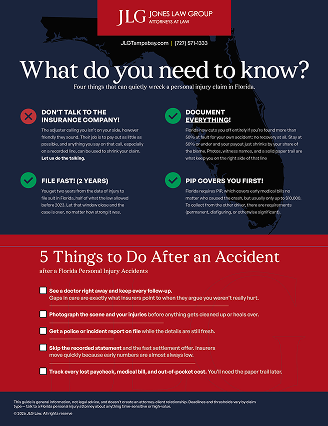
See the things you NEED TO DO after your accident. Get the 5 to-do's sent directly to your email.
