JONES LAW GROUPYour Lawyers for Life! Personal Injury Law Firm in St. Petersburg
Reviewed by Bobby Jones, Personal Injury Attorney, Jones Law Group | Published | Updated .
Getting hurt in an Uber or Lyft in Tampa comes with a complication most car accident victims never face: figuring out which insurance policy is even supposed to pay. Every weekend, Ybor City’s Seventh Avenue and the Channelside/Water Street corridor fill with rideshare vehicles picking up and dropping off passengers, and that volume of stop-and-go traffic mixed with pedestrians and nightlife crowds creates real crash risk. A Tampa rideshare accident lawyer who understands how Uber and Lyft’s insurance coverage actually works can be the difference between a quick denial and a claim that’s paid fairly. Jones Law Group has represented injured passengers, drivers, and pedestrians throughout Hillsborough County and handles rideshare crash cases on contingency, so there’s no upfront cost to find out where you stand.
What catches most injured riders and other drivers off guard is that Uber and Lyft don’t carry one flat insurance policy that applies every time. Instead, Florida law ties the available coverage to the driver’s status in the app at the exact moment of the crash — whether the app was off, on but waiting for a ride request, or actively carrying a passenger. That single fact can shrink an insurance policy from up to a million dollars in coverage down to whatever the driver personally carries, which is why the “which phase were they in” question sits at the center of nearly every rideshare injury case.
Which insurance policy covers a Tampa rideshare crash depends entirely on what the driver’s app was doing when the collision happened. Florida’s TNC law, codified at Fla. Stat. § 627.748, requires companies like Uber and Lyft to carry different levels of coverage depending on the driver’s status, and it recognizes four distinct phases of a trip.
Period 0 (app off): If the driver’s app is completely off, only their personal auto policy applies. A driver carrying Florida’s minimum coverage can leave an injured victim with very little to work with.
Period 1 (app on, waiting for a match): Once a driver logs in and is available for requests but hasn’t accepted a trip, a limited contingent liability policy fills gaps in the driver’s personal coverage. Under Fla. Stat. § 627.748, this typically runs $50,000 per person and $100,000 per incident for bodily injury, plus $25,000 for property damage, and applies only after the personal policy is exhausted or denies the claim.
Periods 2 and 3 (en route to pickup / passenger in the vehicle): From the moment a driver accepts a ride request through drop-off, Uber and Lyft’s own commercial liability policy applies, providing up to $1 million in coverage for bodily injury and property damage, along with uninsured/underinsured motorist coverage in that same range. This is the strongest coverage available in a rideshare crash, and also the phase companies most often dispute.
Because app status isn’t obvious from the outside, insurers frequently argue a driver was in a lower-coverage phase than the victim believes. Pulling trip data and app logs early is often the most important step in a Tampa rideshare injury claim.
Tampa’s rideshare crashes cluster around the places that draw the heaviest pickup and drop-off volume. Ybor City’s nightlife district sends a steady stream of Uber and Lyft drivers through narrow streets crowded with pedestrians late at night, and the Channelside/Water Street area sees similar congestion as downtown workers, hotel guests, and event crowds all call rides at once. Armature Works and Hyde Park Village add bursts of rideshare traffic around dinner and event hours, with drivers double-parking or cutting across lanes to reach a waiting passenger.
Beyond the pickup zones, rideshare drivers spend much of their time on Tampa’s busiest corridors. The I-275/I-4 interchange known locally as Malfunction Junction forces quick merges and lane changes, and a driver glancing at turn-by-turn directions on a phone mount can miss a merging vehicle entirely. The Selmon Expressway’s reversible lanes and the constant stop-and-go along Dale Mabry Highway present similar risks. Rideshare driving adds a layer most crashes don’t have: a driver simultaneously watching the road, the GPS route, and app notifications about the next fare — a documented source of distracted driving in trip-based transportation work.
How a rideshare claim is built depends heavily on who got hurt. A passenger injured while riding in an Uber or Lyft is almost always in Period 2 or 3 of the trip, putting the $1 million commercial policy in play regardless of who caused the crash. A driver of another vehicle struck by a rideshare car has to establish the at-fault driver’s app status first, since that controls whether the claim runs against a minimal personal policy or Uber and Lyft’s commercial coverage. A pedestrian struck near a busy pickup zone in Ybor City or Channelside faces the same question, plus the added challenge of identifying which of several vehicles was actually at fault. Each scenario calls for a different evidence strategy from day one.
Not sure whether the driver’s app status helps or hurts your claim? Call (727) 571-1333 and a Tampa rideshare accident lawyer will walk through it with you at no cost.
Rideshare crashes produce the same range of injuries as any other motor vehicle collision, from whiplash and soft-tissue damage to fractures, head trauma, and spinal injuries, and where a victim is treated often reflects how serious the crash was. Tampa General Hospital on Davis Islands is Tampa Bay’s only ACS-verified Level I trauma center for both adults and children, making it the destination for the most severe rideshare crash injuries in the region. St. Joseph’s Hospital, part of BayCare, operates as a Level II trauma center for adults and children and treats a substantial share of Hillsborough County’s serious accident cases as well. Less severe injuries are frequently treated at urgent care clinics or by a primary care physician in the days after the crash.
Complete medical records are especially important in a rideshare case because there are often multiple insurers reviewing the same injury, deciding whether it happened during a low-coverage phase or a high-coverage one. Consistent documentation from the scene through follow-up care helps prevent an insurer from arguing the injury was minor or unrelated to the crash.
Already being treated for injuries from a Tampa rideshare crash? Speak with our team at (727) 571-1333 before you talk to any insurance adjuster.
A Tampa rideshare claim can include economic damages such as medical bills, lost wages, and property damage, along with non-economic damages for pain and suffering when the injury is serious enough to qualify. Florida’s modified comparative negligence rule under Fla. Stat. § 768.81 also applies: if you’re found more than 50% at fault, you can’t recover from the other party, and if you’re found 50% or less at fault, your award is reduced by your share of responsibility. Because rideshare crashes can involve the driver, the passenger, another motorist, and Uber or Lyft’s insurer all pointing fingers at each other, establishing fault clearly is often the most contested part of the case. For more detail, see our guide on how much a Florida injury settlement is worth and our overview of the two-year deadline for filing suit.
Wondering what your Tampa Uber or Lyft accident claim might be worth? Reach a Tampa rideshare accident attorney at (727) 571-1333 for a free case review.
Attorney Bobby Jones is a U.S. Air Force veteran and a graduate of Stetson University College of Law who has spent more than 20 years representing injured Floridians, including passengers, drivers, and pedestrians hurt in Tampa rideshare crashes. Jones Law Group has recovered more than $50 million for injured clients over the course of Bobby’s career and maintains a 4.9-star client rating. The firm handles Tampa rideshare accident cases on contingency, with no upfront cost and no fee unless we recover compensation for you. To learn more, visit our Tampa personal injury lawyer page.
Under Fla. Stat. section 627.748, Florida recognizes four phases of a rideshare trip: Period 0, when the driver’s app is off and only their personal auto policy applies; Period 1, when the app is on but the driver is waiting for a ride request, triggering a limited contingent policy of roughly $50,000 per person and $100,000 per incident; and Periods 2 and 3, covering the trip from acceptance through drop-off, when Uber or Lyft’s commercial policy of up to $1 million in liability coverage applies.
Yes. A passenger riding in an Uber or Lyft at the time of the crash is almost always covered under the rideshare company’s up-to-$1-million commercial policy, since they’re necessarily in Period 2 or 3 of the trip. A driver of another vehicle struck by a rideshare car first has to establish what phase the rideshare driver was in, because that determines whether the claim is against a minimal personal policy or the much larger commercial policy.
In most cases, Florida law gives you two years from the date of the crash to file a lawsuit under Fla. Stat. section 95.11, as shortened from four years by House Bill 837 in 2023. Missing this deadline generally bars you from pursuing compensation through the courts, so it’s important to speak with an attorney well before the two-year mark.
Rideshare accident lawsuits arising from crashes in Hillsborough County are typically filed at the George E. Edgecomb Courthouse at 800 East Twiggs Street in Tampa, which is the civil filing venue for the Thirteenth Judicial Circuit of Florida.
Jones Law Group handles Tampa rideshare accident cases on a contingency fee basis, meaning there is no upfront cost to hire the firm and no fee unless money is recovered on your behalf. The initial consultation to review your case is free.
If the rideshare driver’s app was off at the time of the crash, only that driver’s personal auto policy applies, and Uber or Lyft’s commercial coverage does not come into play. If that driver carries minimal or no insurance, an injured victim may need to pursue their own uninsured or underinsured motorist coverage, which is one reason it’s important to confirm the driver’s app status early in the claim.
Yes. A pedestrian struck by a rideshare vehicle near a busy pickup area such as Ybor City or Channelside can pursue a claim against the at-fault driver’s applicable insurance policy, which again depends on the driver’s app status at the moment of the crash. Identifying the responsible vehicle in a crowded pickup zone can require reviewing rideshare trip data alongside witness accounts.
If an Uber or Lyft crash in Tampa left you dealing with medical bills, an app-status dispute, and an insurer that isn’t giving straight answers, you don’t have to sort it out alone. Jones Law Group reviews Tampa rideshare accident cases at no cost and works on contingency, so you pay nothing unless we recover money for you. Contact Jones Law Group at (727) 571-1333 to talk through what happened and which insurance policy should be covering your injuries.
Jones Law GroupThis page is for general informational purposes only and does not constitute legal advice. Reading this page or contacting Jones Law Group does not create an attorney-client relationship. Past results, including any reference to $50M+ in recoveries, are cumulative figures from prior cases and do not guarantee or predict a similar outcome in any future case.
Speak with us before time runs out! In Florida, you have a limited window to file a personal injury case, so speak to an Attorney today.
Call our personal injury law office directly at (727) 512-9847

Jones Law Group is a dedicated personal injury lawyer in St. Petersburg, FL, serving the Tampa Bay area since 2006. Our experienced attorneys specialize in car accidents, slip and fall cases, employment law disputes, construction law issues, and overtime wage claims, fighting for maximum compensation on a contingency fee basis. Contact us for a free consultation to discuss your case.
Call our personal injury law office at (727) 512-9847
© Copyright 2006–2025 Jones Law Group Attorneys at Law. All rights reserved. Privacy Policy Terms of Use
Attorney Advertising.
The information on this website is for general information purposes only. Nothing on this site should be taken as legal advice for any individual case or situation. This information is not intended to create, and receipt or viewing does not constitute, an attorney-client relationship. Past results do not guarantee similar outcomes.
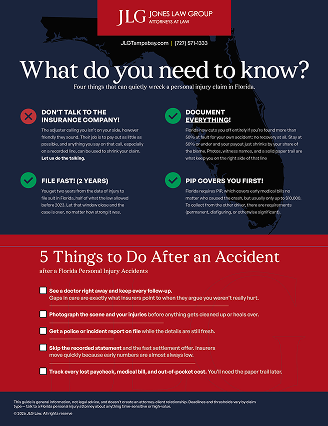
See the things you NEED TO DO after your accident. Get the 5 to-do's sent directly to your email.
