JONES LAW GROUPYour Lawyers for Life! Personal Injury Law Firm in St. Petersburg
Reviewed by Bobby Jones, Personal Injury Attorney, Jones Law Group | Published | Updated
Renting a fat-tire cruiser to loop St. Armands Circle before dinner, or grabbing a throttle e-bike outside Siesta Key Village for a sunset ride down the beach, has become one of the most popular ways visitors and locals get around Sarasota’s barrier islands. It is also a growing source of serious injury claims. If a distracted driver, a defective battery, or a poorly maintained rental fleet put you in the hospital, a Sarasota e-bike accident lawyer can help you sort out who is actually responsible — and how to pay your bills while you recover. Jones Law Group has recovered $50M+ for injured Floridians, and we do not charge a fee unless we win your case.
Most riders assume an e-bike crash claim works just like a car accident case: identify the at-fault driver, file against their insurance, done. But e-bikes complicate that math. Because Florida law splits e-bikes into three distinct classes with different speed limits, throttle rules, and path restrictions, a wreck can raise a second, often-overlooked question — did the bike itself fail? A brake that will not engage, a throttle that sticks, or a battery pack that fails mid-ride can turn what looks like a routine traffic case into a two-front case, with one claim against whoever caused the crash and a second, separate claim against the manufacturer of a defective component.
A Class 1 e-bike under Fla. Stat. § 316.20655 is pedal-assist only, meaning the motor kicks in solely to boost your own pedaling and cuts out at 20 mph. A Class 2 e-bike has a throttle that can move the bike without any pedaling at all, also capped at 20 mph — this is the kind of bike you will usually find in tourist rental fleets around St. Armands Circle and Siesta Key Village, because riders who have never pedaled an e-bike before can twist a throttle and go. A Class 3 e-bike is pedal-assist only, like Class 1, but the motor keeps assisting up to 28 mph, nearly triple the speed of an ordinary bicycle.
The classification matters in a claim for two reasons. First, each class carries different rules about where it can legally travel — some multi-use paths and sidewalks restrict Class 3 bikes because of their higher top speed, while Class 1 and Class 2 bikes are typically welcome on trails like The Legacy Trail. If the e-bike involved in your crash was being ridden somewhere it was not legally permitted, that fact can shift or share fault. Second, the class tells us what components were doing the work at the moment of the crash — a throttle malfunction is a very different defect theory than a pedal-assist sensor malfunction, and knowing which class you rode narrows down what to inspect and preserve as evidence.
The first front in most Sarasota e-bike claims looks familiar: a driver who ran a red light near downtown Sarasota, failed to yield at a roundabout entrance on St. Armands Circle, or drifted into a bike lane while distracted. That claim runs through the at-fault party’s auto liability insurance, and Florida’s comparative negligence rule under Fla. Stat. § 768.81 means your own recovery can be reduced by any percentage of fault assigned to you, though you can still recover as long as you are found less than 51% at fault.
The second front is the one riders rarely think to ask about. If the crash involved a rental e-bike, a personally owned e-bike, or an e-bike conversion kit, and the brakes failed to grip, the throttle stuck open, the motor surged unexpectedly, or the battery ignited, that mechanical failure can support a separate product liability claim against the manufacturer, importer, or distributor — independent of whatever a driver did or did not do. In some crashes, a defective component is the entire cause. In others, it combines with a driver’s negligence to make the outcome worse than it should have been. Either way, identifying a product defect early matters, because the physical bike, its battery, and its onboard data are the evidence, and rental companies are not obligated to preserve a damaged unit once it is off their books. A rental company’s own negligence — for example, sending out an e-bike with a known brake problem or a battery long overdue for replacement — can also create liability against the rental operator itself, separate from any manufacturing defect.
Sarasota’s most popular riding spots are also its most crash-prone. St. Armands Circle packs pedestrians, valet traffic, delivery vehicles, and rental e-bikes into a single tight roundabout, where drivers unfamiliar with yield rules routinely cut off cyclists entering or exiting the circle. Siesta Key Village compresses restaurant and beach traffic onto narrow streets that were never designed for the volume of e-bikes now renting there in season, and low visibility at dusk — a popular e-bike rental window — raises the risk further. The Legacy Trail draws e-bike riders at speeds well above traditional bicycle traffic, and conflicts arise at the road crossings where the trail intersects surface streets and drivers fail to stop for trail users with the right of way.
Barrier-island tourist traffic adds another layer of risk. Anyone riding between the mainland and the keys funnels over a handful of bridges — the John Ringling Causeway connecting downtown Sarasota to St. Armands Circle and Lido Key, and the Siesta Dr. and Stickney Point Rd. bridges onto Siesta Key. These spans see heavy seasonal congestion, narrow shoulders, and drivers focused on beach traffic rather than the e-bike riders sharing the roadway, making bridge approaches some of the most dangerous stretches for Sarasota e-bike riders.
Hurt in an e-bike crash near St. Armands Circle, Siesta Key, or the Legacy Trail? Jones Law Group offers a free, no-obligation case review. Call (727) 571-1333 today to find out what your claim may be worth.
E-bike crashes tend to produce more serious injuries than ordinary bicycle wrecks because higher speeds — up to 28 mph on a Class 3 bike — mean harder impacts. Riders commonly suffer road rash, fractures, shoulder and wrist injuries from bracing for a fall, traumatic brain injury, and spinal injuries, particularly when a helmet was not worn or a vehicle was involved.
Sarasota Memorial Hospital is Sarasota County’s only Level II Trauma Center, ACS-verified, and is where the most severely injured riders are typically transported for immediate surgical and critical care. For less severe injuries, HCA Florida Sarasota Doctors Hospital at 5731 Bee Ridge Rd. operates a 24/7 ER, though it is not a designated trauma center. Where you were treated, and how quickly, becomes part of the medical record that supports your claim — consistent, documented treatment at either facility helps establish the severity of your injuries and ties them directly to the crash.
An e-bike accident claim’s value depends on the medical bills you have incurred and are likely to incur, lost income while you recover, pain and suffering, and any permanent impairment. When a product defect contributes to the crash, damages can also include claims against the manufacturer that go beyond what a driver’s auto policy would cover. Florida’s comparative negligence standard means insurers will look for any way to shift blame onto you — riding without a helmet, or riding a Class 3 bike somewhere it was not permitted, are the kinds of facts an adjuster will raise to reduce a payout, which is exactly why documenting the crash and your e-bike’s classification matters from day one.
For a broader look at how settlement value is calculated in Florida injury cases generally, see our guide on how much a Florida injury settlement is worth. And because Florida’s filing deadline does not wait for you to finish treatment, our two-year deadline guide explains exactly how that clock works and what can extend or shorten it.
Not sure what your Sarasota e-bike case is worth? A free consultation with Jones Law Group costs nothing and comes with no obligation. Reach us at (727) 571-1333 or [email protected].
Bobby Jones has built his practice around exactly this kind of layered case — where more than one party may be responsible for a single crash. Jones Law Group has recovered $50M+ for injured Floridians and holds a 4.9 client rating, but what matters most to a rider just out of Sarasota Memorial is straightforward: we investigate both the driver’s conduct and the e-bike itself, we work on contingency so there is no upfront cost, and we handle the insurance company and, where warranted, the manufacturer, so you can focus on recovering. If your crash happened anywhere else in the area, our Sarasota personal injury lawyer page covers the full range of cases we handle locally.
Ready to talk to someone about your Sarasota e-bike accident? Call Jones Law Group at (727) 571-1333 for a free, no-pressure consultation — we’re available to review the driver’s conduct and the e-bike itself.
A police report is not legally required to file a claim, but it strengthens one significantly. St. Armands Circle and downtown Sarasota fall under Sarasota Police Department jurisdiction, while unincorporated stretches near the Legacy Trail or outside city limits are patrolled by the Sarasota County Sheriff’s Office. Either agency’s report documents the scene, witness statements, and initial fault assessment, which becomes valuable evidence later.
You may still have a claim even though the Legacy Trail is not a public road. If a driver failed to stop at a marked trail crossing, or another trail user’s negligence caused the crash, standard negligence rules apply. If the crash instead involved a mechanical failure on the e-bike itself, that points toward a product liability claim against the manufacturer rather than, or in addition to, a driver.
Potentially. Rental companies have a duty to maintain their fleets and provide bikes free of known defects. If a rental company sent out an e-bike with worn brakes, a faulty throttle, or a battery it knew was failing, that negligence can support a claim against the rental operator separate from any claim against the bike’s original manufacturer.
Most injured riders have two years from the date of the crash to file a lawsuit in Florida. Cases filed in Sarasota County go through the Twelfth Judicial Circuit at the Judge Lynn N. Silvertooth Judicial Center. Missing this deadline generally bars recovery entirely, so it is worth speaking to a lawyer well before it approaches.
You can still recover damages under Florida’s comparative negligence rule as long as you are found less than 51% at fault, though your recovery is reduced by your percentage of fault. Riding without a helmet or riding a Class 3 e-bike somewhere it was not permitted are common facts insurers raise to argue partial fault, which is why documenting your e-bike’s classification and the crash location matters.
Yes. Florida Statute 316.20655 sets different speed limits and path rules for Class 1 (pedal-assist, 20 mph), Class 2 (throttle-assisted, 20 mph), and Class 3 (pedal-assist, 28 mph) e-bikes. The class affects where the bike was legally allowed to be ridden, which can shift fault, and it also narrows down which components — throttle, pedal-assist sensor, or speed governor — to inspect for a possible defect.
Jones Law Group represents injured e-bike riders on contingency, meaning there is no upfront cost and no fee unless we recover money on your behalf. A free consultation is available at (727) 571-1333 to review the facts of your crash before you decide anything.
If you or someone you love was hurt riding an e-bike near St. Armands Circle, Siesta Key Village, downtown Sarasota, or The Legacy Trail, do not assume the driver’s insurance is your only source of recovery. A quick, free case review can determine whether a defective battery, brake, or throttle also played a role — and how much time you have left to act. Call Jones Law Group at (727) 571-1333 or email [email protected]; we work on contingency, so there is no fee unless we win.
Jones Law GroupThis page is for general informational purposes only and does not constitute legal advice. Reading this page or contacting Jones Law Group does not create an attorney-client relationship. Past results, including any reference to $50M+ in recoveries, are cumulative figures from prior cases and do not guarantee or predict a similar outcome in any future case.
Speak with us before time runs out! In Florida, you have a limited window to file a personal injury case, so speak to an Attorney today.
Call our personal injury law office directly at (727) 512-9847

Jones Law Group is a dedicated personal injury lawyer in St. Petersburg, FL, serving the Tampa Bay area since 2006. Our experienced attorneys specialize in car accidents, slip and fall cases, employment law disputes, construction law issues, and overtime wage claims, fighting for maximum compensation on a contingency fee basis. Contact us for a free consultation to discuss your case.
Call our personal injury law office at (727) 512-9847
© Copyright 2006–2025 Jones Law Group Attorneys at Law. All rights reserved. Privacy Policy Terms of Use
Attorney Advertising.
The information on this website is for general information purposes only. Nothing on this site should be taken as legal advice for any individual case or situation. This information is not intended to create, and receipt or viewing does not constitute, an attorney-client relationship. Past results do not guarantee similar outcomes.
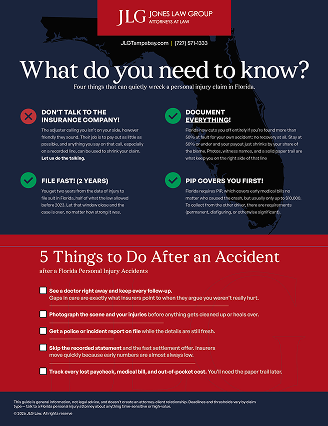
See the things you NEED TO DO after your accident. Get the 5 to-do's sent directly to your email.
