JONES LAW GROUPYour Lawyers for Life! Personal Injury Law Firm in St. Petersburg
Reviewed by Bobby Jones, Personal Injury Attorney, Jones Law Group | Published | Updated
If you’ve ever sat through three light cycles at SR 50 (Colonial Dr) & SR 436 or watched a rental car brake-check its way through the I-4 corridor near downtown, you already know why an Orlando car accident lawyer stays busy. Central Florida’s mix of theme-park tourists, commuter gridlock, and constant I-4 construction produces some of the state’s most congested — and most dangerous — roadways, and when a crash happens on them, the medical and legal fallout moves fast. At Jones Law Group, our attorneys built their practice on trial experience and Florida injury law, and we represent injured Orlando drivers on contingency — you owe nothing unless we recover for you.
What most people don’t realize is that the clock on their own insurance benefits starts ticking before they’ve even decided whether to see a doctor. Florida’s no-fault system requires you to seek initial medical treatment within 14 days of the crash or risk losing access to your own PIP coverage entirely — the “wait and see if I’m really hurt” instinct that feels responsible is often the exact mistake that costs accident victims thousands of dollars in medical bills they assumed insurance would cover.
Florida’s no-fault insurance law, Fla. Stat. § 627.736, requires every driver’s own Personal Injury Protection (PIP) policy to pay the first $10,000 of medical bills and lost wages after a crash — regardless of who caused it. That part is straightforward. The part that trips people up is the deadline: under the statute, you must receive initial medical treatment within 14 days of the accident, or your insurer can lawfully deny PIP coverage altogether.
This matters enormously in Orlando, where a low-speed collision at Colonial Dr & John Young Pkwy or a fender-bender crawling along International Drive can leave someone feeling “just sore” for a week or two before symptoms like whiplash, disc injuries, or concussion effects fully surface. Waiting to see if the pain resolves on its own is a natural reaction — but if you cross the 14-day mark without a documented visit to a physician, physician assistant, dentist, or other qualifying provider, your PIP carrier has statutory grounds to refuse the claim, leaving you responsible for bills that should have been covered.
There’s a second layer most crash victims never hear about: to receive the full 80% PIP benefit on medical expenses, a treating provider must determine you have an emergency medical condition — a condition with acute symptoms severe enough that a lack of immediate care could reasonably be expected to place your health in serious jeopardy. Without that determination, PIP coverage is capped at $2,500, regardless of how much treatment you actually need. Getting evaluated quickly, and by the right kind of provider, directly affects how much of your care gets paid for.
If your injuries are serious or permanent — meeting Florida’s injury threshold under the same statute — PIP is only the starting point. That threshold opens the door to a claim against the at-fault driver for the damages PIP doesn’t cover: full lost wages, future medical care, and pain and suffering.
Orlando’s crash patterns trace back to a handful of well-documented problem corridors. The intersection of SR 50 (Colonial Dr) & SR 436 is one of the region’s most frequently cited high-crash locations, where heavy east-west commuter traffic collides with north-south arterial flow during rush hour. Colonial Dr & John Young Pkwy and the stretch of OBT/Orange Blossom Trail (US-441) & Oak Ridge Rd see similarly dense collision activity, driven by frequent turning movements, closely spaced signals, and drivers cutting across multiple lanes to catch a light.
Near the tourist corridor, Kirkman Rd & Vineland Rd — close to Universal Orlando — regularly produces crashes tied to distracted rental-car drivers and heavy pedestrian and shuttle traffic. The Lee Rd & I-4 interchange is another recurring hotspot, where merging highway traffic meets surface-street congestion. And the I-4 corridor itself is widely regarded as Central Florida’s deadliest interstate stretch, with ongoing construction, sudden slowdowns, and dense weekday traffic combining to produce serious, often high-speed collisions.
Orlando’s tourism economy compounds the risk. International Drive (“I-Drive”) — a tourist-saturated corridor that is mostly unincorporated Orange County — draws a constant stream of out-of-town drivers unfamiliar with local traffic patterns, simultaneously reading GPS directions and adjusting to unfamiliar rental cars. That mix of theme-park visitors, hotel shuttles, pedestrians, and confused merges produces the intersection collisions, rear-end impacts, and sideswipes that fill Orlando’s crash reports year-round. It also matters for jurisdiction: crashes within Orlando’s city limits are typically investigated by the Orlando Police Department (OPD), while collisions in unincorporated areas — including most of I-Drive and the theme park perimeter — fall under the Orange County Sheriff’s Office (OCSO).
Hurt in an Orlando crash? Get a free, no-obligation case review from Jones Law Group. Call (727) 571-1333 or reach out online — we work on contingency, so there’s no fee unless we win.
Where you’re treated after an Orlando car accident often depends on how severe your injuries are. Orlando Regional Medical Center (ORMC), part of Orlando Health in downtown Orlando, is Central Florida’s only verified Level I Trauma Center for adults — equipped to handle the most severe injuries, including traumatic brain injuries, internal bleeding, spinal trauma, and multi-system trauma that often result from high-speed collisions on the I-4 corridor or serious intersection crashes along SR 50. If you’re transported by ambulance from a serious wreck anywhere in the region, this is typically where you’ll end up.
ORMC sits adjacent to Arnold Palmer Hospital, which handles pediatric trauma for children injured in car accidents — an important distinction for families involved in crashes near the theme park corridors and I-Drive, where children are frequently passengers. Together, these two facilities form the backbone of serious trauma care for the Orlando area.
Whichever facility treats you, the medical records generated there do double duty: they document your injuries for your health and they become the evidentiary backbone of your insurance claim. This is exactly why the 14-day PIP treatment window matters so much — the sooner you’re seen and the more thoroughly your provider documents an emergency medical condition, the stronger the paper trail supporting both your PIP claim and any later claim against the at-fault driver.
Every Orlando car accident claim is built from several categories of damages: past and future medical expenses, lost wages and diminished earning capacity, property damage to your vehicle, and — for claims that meet Florida’s injury threshold — pain and suffering. The value of your claim depends heavily on the severity and permanence of your injuries, the strength of your medical documentation, and how clearly liability can be established against the other driver.
Florida follows a comparative negligence rule, meaning your compensation is reduced by whatever percentage you’re found responsible for the crash — and under current Florida law, a plaintiff found more than 50% at fault is barred from recovering damages at all. That makes it critical to have an attorney who can push back on unfair fault allocations early, before an insurance adjuster’s narrative becomes the default version of events. For a deeper breakdown of how these categories add up, see our guide on how much a Florida injury settlement is worth.
Timing matters just as much as valuation. Florida law gives most injury victims two years from the date of the crash to file a lawsuit — our two-year deadline guide explains the exceptions and why waiting even a few months to get organized can weaken a claim. If your case isn’t resolved through negotiation, it would be filed at the Orange County Courthouse, 425 N. Orange Ave, Orlando, FL 32801, within the Ninth Judicial Circuit, which also covers Osceola County.
Not sure what your Orlando claim is worth? Jones Law Group offers free case evaluations — call (727) 571-1333 and speak with our team today.
Bobby Jones and the attorneys at Jones Law Group have built a practice around trial-ready representation for Florida crash victims, having helped clients recover more than $50M in cumulative results across prior cases. The firm maintains a 4.9-star client rating built on direct communication, careful handling of PIP and medical-provider disputes, and a willingness to take cases to court when insurers won’t offer a fair settlement. Every car accident case is handled on contingency — you pay nothing upfront, and there’s no fee unless we recover compensation for you.
Whether your crash happened at SR 50 & SR 436, along the I-4 corridor, or anywhere near International Drive, our team understands the local roads, the hospitals that treat Orlando crash victims, and the Ninth Judicial Circuit court system where these cases are filed. For broader representation across all injury types in the area, visit our Orlando personal injury lawyer page.
Florida law requires you to receive initial medical treatment within 14 days of the crash under Fla. Stat. § 627.736. If you wait longer than 14 days, your PIP insurer can lawfully deny coverage for your accident-related medical bills.
Personal Injury Protection (PIP) pays the first $10,000 of your medical bills and lost wages regardless of who caused the accident. Full 80% medical coverage requires a treating provider to determine you have an emergency medical condition; otherwise coverage is capped at $2,500.
You can pursue a claim against the at-fault driver if your injuries meet Florida’s injury threshold, meaning they are serious or permanent. That claim can recover damages PIP does not cover, including full lost wages, future medical costs, and pain and suffering.
Civil injury lawsuits from Orange County crashes are filed at the Orange County Courthouse, 425 N. Orange Ave, Orlando, FL 32801, within Florida’s Ninth Judicial Circuit, which also covers Osceola County.
Orlando Regional Medical Center (ORMC), part of Orlando Health in downtown Orlando, is Central Florida’s only verified Level I Trauma Center for adults. Arnold Palmer Hospital, located adjacent to ORMC, handles pediatric trauma for children injured in car accidents.
Florida’s statute of limitations generally gives injury victims two years from the date of the accident to file a lawsuit. Missing this deadline typically bars you from recovering compensation through the courts, so early legal guidance matters.
Florida uses a comparative negligence system, so your compensation is reduced by your percentage of fault. However, if you are found more than 50% at fault for the crash, you are barred from recovering damages entirely.
If you’ve been hurt in a crash on the I-4 corridor, at SR 50 & SR 436, or anywhere else in Orange County, the clock on your PIP benefits is already running. Jones Law Group can help you get treated within the 14-day window, document your injuries properly, and pursue every avenue of compensation available under Florida law — all on contingency, with no upfront fees. Call (727) 571-1333 today for a free, no-obligation consultation.
Jones Law GroupThis page is for general informational purposes only and does not constitute legal advice. Reading this page or contacting Jones Law Group does not create an attorney-client relationship. Past results, including any reference to $50M+ in recoveries, are cumulative figures from prior cases and do not guarantee or predict a similar outcome in any future case.
Speak with us before time runs out! In Florida, you have a limited window to file a personal injury case, so speak to an Attorney today.
Call our personal injury law office directly at (727) 512-9847

Jones Law Group is a dedicated personal injury lawyer in St. Petersburg, FL, serving the Tampa Bay area since 2006. Our experienced attorneys specialize in car accidents, slip and fall cases, employment law disputes, construction law issues, and overtime wage claims, fighting for maximum compensation on a contingency fee basis. Contact us for a free consultation to discuss your case.
Call our personal injury law office at (727) 512-9847
© Copyright 2006–2025 Jones Law Group Attorneys at Law. All rights reserved. Privacy Policy Terms of Use
Attorney Advertising.
The information on this website is for general information purposes only. Nothing on this site should be taken as legal advice for any individual case or situation. This information is not intended to create, and receipt or viewing does not constitute, an attorney-client relationship. Past results do not guarantee similar outcomes.
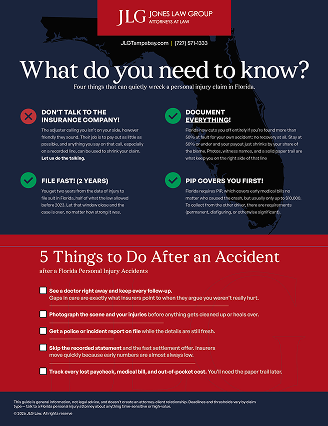
See the things you NEED TO DO after your accident. Get the 5 to-do's sent directly to your email.
