JONES LAW GROUPYour Lawyers for Life! Personal Injury Law Firm in St. Petersburg
Reviewed by Bobby Jones, Personal Injury Attorney, Jones Law Group | Published | Updated
Rent a Lime or Bird e-bike on International Drive or grab one for a sunset loop around Lake Eola, and it feels like the easiest way to see downtown Orlando — right up until a driver rolls through a crosswalk or a rental bike’s motor surges unexpectedly and you’re on the pavement. An Orlando e-bike accident lawyer at Jones Law Group can tell you that these crashes are rarely as simple as “car versus bike.” At Jones Law Group, our attorneys built their practice on trial experience and Florida injury law, and we represent injured Orlando e-bike riders on contingency — you owe nothing unless we recover for you.
Here’s what most riders never consider: an e-bike crash can be a two-front case. There’s the obvious front — the driver, rideshare operator, or other party whose negligence caused the collision. But there’s often a second, hidden front — a potential product liability claim against the e-bike or e-scooter manufacturer if a battery fire, motor malfunction, or brake failure contributed to the crash. Riders who only pursue the driver can leave real compensation on the table, especially when the bike itself failed at the worst possible moment.
Florida law does not treat all e-bikes the same. Under Fla. Stat. § 316.20655, every electric bicycle sold or ridden in the state falls into one of three classes, and the class determines how fast the bike can legally go, whether it can be throttle-powered, and — critically — where it’s allowed to be ridden.
A Class 1 e-bike is pedal-assist only, meaning the motor only engages while you’re pedaling, and it cuts off once the bike reaches 20 mph. A Class 2 e-bike also tops out at 20 mph but adds a throttle, so the rider can accelerate without pedaling at all — a feature common on many I-Drive rental fleets. A Class 3 e-bike is pedal-assist only, like Class 1, but the motor keeps assisting up to 28 mph, making it the fastest and, in a collision, often the most dangerous of the three.
These distinctions matter well beyond trivia. Class 3 e-bikes generally cannot be ridden on multi-use paths and sidewalks the way Class 1 and Class 2 bikes often can, and local ordinances can further restrict where each class is allowed. When a crash happens, figuring out which class of e-bike was involved — and whether it was being ridden somewhere it legally shouldn’t have been — can shape the entire fault analysis. A rider on an improperly located Class 3 bike may face a comparative negligence argument from an insurer; a rider following the rules for their bike’s class has a much cleaner path to full compensation.
Most people who get hurt on an e-bike assume there’s exactly one party to blame: whoever hit them. In many Orlando e-bike crashes, that’s true — a driver who fails to yield, runs a red light, or doesn’t check a mirror before turning is squarely liable under ordinary negligence principles. But e-bikes are electromechanical vehicles with batteries, motors, and brake systems that can fail on their own, and that opens a second front most riders never think to investigate.
If a battery cell short-circuits and the bike suddenly loses power mid-ride, if a motor controller malfunctions and causes an unintended surge of speed, or if the brakes fail to engage because of a manufacturing or design defect, the rider may have a product liability claim against the manufacturer, distributor, or — in the case of a dockless rental — the fleet operator responsible for maintaining the bike. This claim exists independently of whatever a driver did or didn’t do, and it can be pursued alongside a negligence claim rather than instead of one.
This matters most with dockless rental fleets, where hundreds of e-bikes and scooters see daily wear, get dropped, get left in the rain, and get serviced on a rotating maintenance schedule rather than by a single dedicated owner. A frayed brake cable or a battery that’s been swapped one too many times can turn a routine ride into a crash — and because the rider never owned or serviced the bike, they often have no idea a mechanical defect is even a possibility until an attorney starts asking questions about maintenance records and prior incident reports.
Orlando’s e-bike and e-scooter crashes cluster around the same places tourists and downtown workers rent them. International Drive (“I-Drive”) is the region’s busiest micromobility corridor — a dense mix of hotel shuttles, rental cars driven by out-of-towners unfamiliar with the area, pedestrians darting between attractions, and riders weaving through traffic on rented e-bikes and scooters. Downtown, the area around Lake Eola draws a similar crowd of riders looping the park on rented bikes, often crossing multiple lanes of traffic and navigating drivers who aren’t expecting a 20 mph e-bike in a bike lane designed for slower, pedal-only traffic.
The city’s regulatory framework adds another layer worth understanding. Orlando’s Lime and Bird e-scooter permit program caps rental scooter speeds at 10 mph and uses geofencing technology to restrict where scooters can be parked or ridden, including no-parking zones around high-pedestrian areas like Lake Eola. When a rental scooter or e-bike is found to have been speeding past its geofenced or permitted limit at the time of a crash, that fact can become part of the fault analysis — a violation of the operator’s own permit terms can support an argument that the rider (or the platform’s throttle-limiting technology) contributed to the collision, or conversely, that the platform failed to properly cap the vehicle’s speed as required.
Rental liability waivers add one more wrinkle. Nearly every Lime, Bird, or similar rental app requires users to click through a liability waiver before unlocking a bike or scooter. These waivers are written broadly, but they typically don’t — and under Florida law generally can’t — waive a rider’s right to pursue a third-party driver who caused the crash, and they rarely bar a product liability claim tied to a genuine mechanical defect. Riders often assume the waiver ends their options entirely; in practice, it usually just narrows what can be claimed directly against the rental operator itself.
Hurt on an e-bike or rental scooter in Orlando? Get a free, no-obligation case review from Jones Law Group. Call (727) 571-1333 or reach out online — we work on contingency, so there’s no fee unless we win.
E-bike and e-scooter crashes tend to produce injuries that are more severe than a typical pedal-bike spill, simply because of speed. A rider thrown from a Class 3 e-bike moving near 28 mph, or struck by a vehicle while riding at 20 mph through an I-Drive intersection, can suffer traumatic brain injuries, fractures, road rash requiring skin grafts, and spinal trauma. Orlando Regional Medical Center (ORMC), part of Orlando Health in downtown Orlando, is Central Florida’s only verified Level I Trauma Center for adults and is typically where the most seriously injured riders are transported.
ORMC sits adjacent to Arnold Palmer Hospital, which handles pediatric trauma — relevant given how many families rent e-bikes together near Lake Eola and the theme park corridors, and how often children end up as passengers or riders on rental bikes not designed with a child’s weight or reaction time in mind.
Whichever facility treats you, prompt and thorough documentation matters just as much here as in any other injury case — and arguably more, because it may need to support two separate claims at once. A medical record that clearly ties your injuries to the crash mechanism (a broken brake lever, an unexpected throttle surge, a driver’s failure to yield) strengthens both the negligence claim against the at-fault party and any product liability claim against the bike’s manufacturer or operator.
An Orlando e-bike accident claim is valued the same way most Florida injury claims are: by adding up past and future medical expenses, lost wages and diminished earning capacity, property damage, and pain and suffering tied to the severity and permanence of your injuries. What makes e-bike claims distinct is that damages may be recoverable from more than one source — a driver’s auto insurance policy, a rental operator’s commercial liability coverage, and a manufacturer’s product liability coverage can all potentially contribute to a full recovery, depending on what caused the crash.
Florida follows a comparative negligence rule, meaning your compensation is reduced by whatever percentage of fault you’re assigned — and a rider found more than 50% at fault is barred from recovering damages at all. This is exactly where e-bike class, path-use rules, and rental permit violations tend to surface in an insurer’s defense strategy, which is why identifying every potential source of liability early matters so much. For a deeper breakdown of how these damage categories add up, see our guide on how much a Florida injury settlement is worth.
Timing matters just as much as valuation. Florida law generally gives injury victims two years from the date of the crash to file suit — our two-year deadline guide explains the exceptions and why early action protects evidence like a rental company’s maintenance logs before it’s lost or overwritten. If your case isn’t resolved through negotiation, it would be filed at the Orange County Courthouse, 425 N. Orange Ave, Orlando, FL 32801, within the Ninth Judicial Circuit.
Not sure what your Orlando e-bike claim is worth? Jones Law Group offers free case evaluations — call (727) 571-1333 and speak with our team today.
Bobby Jones and the attorneys at Jones Law Group have built a practice around trial-ready representation for Florida crash victims, having helped clients recover more than $50M in cumulative results across prior cases. The firm maintains a 4.9-star client rating built on direct communication, careful handling of multi-party claims, and a willingness to investigate every angle of liability — including product defects that other firms might overlook — rather than settling for whatever a single insurer offers first. Every e-bike accident case is handled on contingency — you pay nothing upfront, and there’s no fee unless we recover compensation for you.
Whether your crash happened on I-Drive, near Lake Eola, or anywhere else in Orange County, our team understands the local rental programs, the hospitals that treat Orlando crash victims, and the Ninth Judicial Circuit court system where these cases are filed. For broader representation across all injury types in the area, visit our Orlando personal injury lawyer page.
Under Fla. Stat. § 316.20655, Class 1 e-bikes are pedal-assist only up to 20 mph, Class 2 e-bikes add a throttle and also cap at 20 mph, and Class 3 e-bikes are pedal-assist only but can assist up to 28 mph. Each class has different rules for where it can legally be ridden.
Yes. An Orlando e-bike crash can be a two-front case: a negligence claim against the driver or other at-fault party, and a separate product liability claim against the e-bike or battery manufacturer if a mechanical defect like a brake or motor failure contributed to the collision. These claims can be pursued at the same time.
It can. Orlando’s Lime and Bird e-scooter permit program caps rental speeds at 10 mph and geofences no-parking zones around areas like Lake Eola. If a rental vehicle exceeded its permitted speed or ignored a geofenced restriction at the time of a crash, that fact can factor into the fault analysis for the claim.
Usually not entirely. Rental liability waivers are written broadly, but they generally do not waive a rider’s right to pursue a third-party driver who caused the crash, and they rarely bar a product liability claim tied to a genuine mechanical defect. The waiver typically limits what can be claimed directly against the rental operator, not against other liable parties.
Orlando Regional Medical Center (ORMC), part of Orlando Health in downtown Orlando, is Central Florida’s only verified Level I Trauma Center for adults. Arnold Palmer Hospital, located adjacent to ORMC, handles pediatric trauma for children injured while riding or riding as passengers on e-bikes.
Florida’s statute of limitations generally gives injury victims two years from the date of the crash to file a lawsuit. Missing this deadline typically bars recovery through the courts, so early legal guidance matters, especially when a rental company’s maintenance records need to be preserved.
Florida uses a comparative negligence system, so your compensation is reduced by your percentage of fault rather than eliminated outright, unless you are found more than 50% at fault. Riding a Class 3 e-bike on a restricted path, for example, could factor into that percentage, but it does not automatically bar a claim against a negligent driver or a defective bike’s manufacturer.
If you’ve been hurt on a rented or personal e-bike in downtown Orlando, along I-Drive, or anywhere else in Orange County, don’t assume your only option is a claim against the driver who hit you. Jones Law Group will investigate the full picture — the crash itself, the e-bike’s class and condition, and whether a rental operator or manufacturer bears any responsibility — and pursue every available avenue of compensation under Florida law, all on contingency, with no upfront fees. Call (727) 571-1333 today for a free, no-obligation consultation.
Jones Law GroupThis page is for general informational purposes only and does not constitute legal advice. Reading this page or contacting Jones Law Group does not create an attorney-client relationship. Past results, including any reference to $50M+ in recoveries, are cumulative figures from prior cases and do not guarantee or predict a similar outcome in any future case.
Speak with us before time runs out! In Florida, you have a limited window to file a personal injury case, so speak to an Attorney today.
Call our personal injury law office directly at (727) 512-9847

Jones Law Group is a dedicated personal injury lawyer in St. Petersburg, FL, serving the Tampa Bay area since 2006. Our experienced attorneys specialize in car accidents, slip and fall cases, employment law disputes, construction law issues, and overtime wage claims, fighting for maximum compensation on a contingency fee basis. Contact us for a free consultation to discuss your case.
Call our personal injury law office at (727) 512-9847
© Copyright 2006–2025 Jones Law Group Attorneys at Law. All rights reserved. Privacy Policy Terms of Use
Attorney Advertising.
The information on this website is for general information purposes only. Nothing on this site should be taken as legal advice for any individual case or situation. This information is not intended to create, and receipt or viewing does not constitute, an attorney-client relationship. Past results do not guarantee similar outcomes.
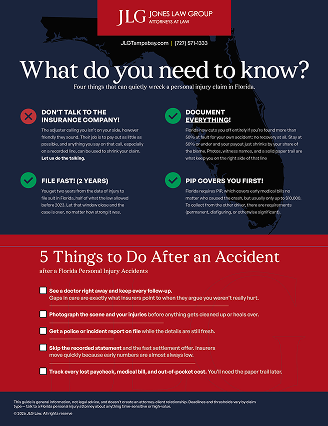
See the things you NEED TO DO after your accident. Get the 5 to-do's sent directly to your email.
