JONES LAW GROUPYour Lawyers for Life! Personal Injury Law Firm in St. Petersburg
Reviewed by Bobby Jones, Personal Injury Attorney, Jones Law Group | Published | Updated
If you’ve ever watched a family cross six lanes of International Drive (“I-Drive”) to get from a hotel to a restaurant, or tried to reach a bus stop across Colonial Dr (SR 50) without a crosswalk in sight for a quarter mile, you already understand why an Orlando pedestrian accident lawyer is often the first call a victim’s family makes. Orlando’s tourist corridors and wide arterial roads were built for cars moving fast, not for the tens of thousands of visitors and residents who walk them every day, and when a driver strikes a pedestrian on one of these roads, the injuries tend to be severe and the insurance fight tends to be immediate. Jones Law Group represents injured Orlando pedestrians on contingency — you owe nothing unless we recover for you.
One of the first things an insurance adjuster will try to do after an Orlando pedestrian crash is shift blame onto the person who got hit. Adjusters routinely argue that a pedestrian was “jaywalking,” crossed against a signal, or wasn’t visible enough — even when the pedestrian had the legal right of way. This tactic is especially common on Central Florida’s high-speed tourist corridors, where crosswalks are spaced far apart and pedestrians are often forced to cross where they can rather than where a signal happens to exist. It matters even more given that the Orlando-Kissimmee-Sanford metro has repeatedly ranked among the most dangerous metro areas in the country for pedestrians in national “Dangerous by Design” reporting, with one report tallying 437 pedestrian deaths metro-wide between 2018 and 2022. That statistic isn’t an abstraction — it reflects the same wide, high-speed roads that Orlando pedestrians cross every day.
Florida pedestrians have the right of way in every marked and unmarked crosswalk, and drivers are legally required to yield to them, under Fla. Stat. § 316.130. The statute doesn’t only protect people crossing at a painted crosswalk with signals — it also extends right-of-way protection to unmarked crosswalks, which are simply the logical extensions of a sidewalk across an intersection, even where no paint or signage exists. Drivers turning at intersections, entering or exiting driveways, and approaching any crosswalk are all required to yield.
What the statute does not say is that a pedestrian forfeits protection simply for crossing mid-block or outside a marked crosswalk. Florida law still requires drivers to exercise due care to avoid colliding with any pedestrian on the roadway, regardless of where exactly they’re crossing, and it specifically prohibits drivers from using the presence of a crosswalk as an excuse to ignore pedestrians elsewhere on the road. This distinction is critical in Orlando, where the practical reality of wide tourist corridors like I-Drive often forces pedestrians to cross well outside the nearest marked crosswalk simply because the nearest one might be a half-mile away.
Despite this clear legal framework, insurance adjusters routinely lean on the word jaywalking — a term with no formal legal weight in a right-of-way analysis — to suggest an injured pedestrian was automatically at fault. An experienced Orlando pedestrian accident lawyer can push back on that narrative by pulling crash reports, traffic camera footage, signal timing data, and witness statements that show what the law actually required of the driver at that specific location.
Orlando’s pedestrian crash patterns trace directly back to how its busiest corridors are built. International Drive carries an enormous volume of tourist foot traffic — visitors walking between hotels, restaurants, and attractions — mixed with dense vehicle and rideshare traffic pulling in and out of driveways and drop-off zones all day and night. Many of those visitors are unfamiliar with the area, distracted by GPS directions or sightseeing, and crossing on foot in a corridor that was designed primarily to move cars.
Colonial Dr (SR 50) and Orange Blossom Trail (OBT/US-441) present a different but equally serious problem: they are wide, high-speed arterial roads with multiple lanes in each direction and crosswalks that can be spaced far apart. A pedestrian trying to reach a bus stop, apartment complex, or shopping center on the opposite side of Colonial Dr or OBT may have to walk a significant distance out of their way to find a signalized crossing — or attempt to cross where they are, in gaps between fast-moving traffic. Higher speeds mean less time for drivers to react and far more severe injuries when a collision occurs.
This is not a coincidental pattern. National “Dangerous by Design” reporting has repeatedly identified the Orlando-Kissimmee-Sanford metro as one of the most dangerous metro areas in the country for pedestrians, citing exactly this combination of wide, high-speed arterial roads, sparse crosswalk spacing, and heavy mixed pedestrian-vehicle traffic in tourist zones. Understanding that context matters for injured pedestrians and their families, because it undercuts any suggestion that a crash was simply the pedestrian’s fault for “being in the wrong place” — the road design itself is a known, documented contributor to pedestrian danger in this region.
Hit by a car while walking in Orlando? Get a free, no-obligation case review from Jones Law Group. Call (727) 571-1333 or reach out online — we work on contingency, so there’s no fee unless we win.
Pedestrians struck by vehicles absorb the force of the impact directly, with no metal frame or airbags to soften the blow, which is why pedestrian crash injuries tend to be more severe than typical vehicle-to-vehicle collision injuries. Orlando Regional Medical Center (ORMC), part of Orlando Health in downtown Orlando, is Central Florida’s only verified Level I Trauma Center for adults — equipped to treat traumatic brain injuries, spinal cord damage, internal bleeding, multiple fractures, and other severe trauma common after a pedestrian is struck on a high-speed corridor like Colonial Dr or OBT.
ORMC sits adjacent to Arnold Palmer Hospital, which handles pediatric trauma for children injured in accidents. This distinction matters for Orlando families in particular, given how many children walk with parents through tourist areas like I-Drive and near theme park entrances, where pedestrian-vehicle conflicts are common.
Because pedestrian injuries are often catastrophic and long-term, the medical records generated at these facilities carry significant weight in an injury claim. Thorough documentation of the emergency treatment, imaging, surgical intervention, and follow-up care establishes both the severity of the harm and the ongoing costs a victim will face — evidence that becomes central to countering any attempt by an insurer to minimize the claim.
An Orlando pedestrian accident claim is generally built from several categories of damages: past and future medical expenses, lost wages and diminished earning capacity, and pain and suffering for the physical and emotional toll of the injury. Because pedestrian injuries tend to be more severe than typical car-to-car collision injuries, the medical costs and long-term impact on a victim’s life are often substantial, which can significantly increase the value of a properly documented claim.
Florida’s comparative negligence rule means your compensation can be reduced by whatever percentage of fault is assigned to you — and this is exactly where insurers focus their energy in pedestrian cases, arguing the pedestrian wasn’t in a crosswalk, wasn’t visible, or should have waited longer to cross. Under current Florida law, a pedestrian found more than 50% at fault is barred from recovering damages entirely, which makes it critical to have an attorney who can challenge an unfair fault allocation with real evidence before it becomes the insurer’s default narrative. For a fuller breakdown of how these damage categories are calculated, see our guide on how much a Florida injury settlement is worth.
Timing is just as important as valuation. Florida law generally gives injury victims two years from the date of the crash to file a lawsuit — our two-year deadline guide explains the exceptions and why waiting to get organized can weaken a claim. If a pedestrian accident case in Orange County isn’t resolved through negotiation, it would be filed at the Orange County Courthouse, 425 N. Orange Ave, Orlando, FL 32801, within the Ninth Judicial Circuit.
Not sure what your Orlando pedestrian accident claim is worth? Jones Law Group offers free case evaluations — call (727) 571-1333 and speak with our team today.
Bobby Jones and the attorneys at Jones Law Group have built a practice around trial-ready representation for Florida pedestrian accident victims, having helped clients recover more than $50M in cumulative results across prior cases. The firm maintains a 4.9-star client rating built on direct communication and a willingness to push back hard against insurers who try to shift blame onto injured pedestrians using Florida’s crosswalk laws as leverage rather than a shield. Every pedestrian accident case is handled on contingency — you pay nothing upfront, and there’s no fee unless we recover compensation for you.
Whether your accident happened on International Drive, along Colonial Dr, or anywhere near Orange Blossom Trail, our team understands the local roads, the trauma centers that treat Orlando pedestrian victims, and the Ninth Judicial Circuit court system where these cases are filed. For broader representation across all injury types in the area, visit our Orlando personal injury lawyer page.
Under Fla. Stat. § 316.130, pedestrians have the right of way in both marked and unmarked crosswalks, and drivers are legally required to yield to them. Drivers turning at intersections or entering driveways must also yield to pedestrians crossing their path.
An insurer can argue you were partly at fault, but jaywalking is not an automatic bar to recovery under Florida law. Florida uses a comparative negligence system, so a pedestrian who was not in a marked crosswalk can still recover compensation unless they are found more than 50% at fault.
National Dangerous by Design reporting has repeatedly ranked the Orlando-Kissimmee-Sanford metro among the most dangerous U.S. metro areas for pedestrians, citing 437 pedestrian deaths metro-wide from 2018 to 2022 in one report. Wide, high-speed arterial roads like Colonial Dr and Orange Blossom Trail, combined with sparse crosswalk spacing and heavy tourist foot traffic on corridors like International Drive, contribute to this ranking.
Civil pedestrian injury lawsuits from Orange County are filed at the Orange County Courthouse, 425 N. Orange Ave, Orlando, FL 32801, within Florida’s Ninth Judicial Circuit.
Orlando Regional Medical Center (ORMC), part of Orlando Health in downtown Orlando, is Central Florida’s only verified Level I Trauma Center for adults. Arnold Palmer Hospital, located adjacent to ORMC, handles pediatric trauma for children injured in pedestrian accidents.
Florida’s statute of limitations generally gives injury victims two years from the date of the accident to file a lawsuit. Missing this deadline typically bars you from recovering compensation through the courts, so early legal guidance matters.
Florida uses a comparative negligence system, so your compensation is reduced by your percentage of fault rather than eliminated outright. However, if you are found more than 50% at fault for the accident, you are barred from recovering damages entirely.
If you or someone you love was struck while walking on International Drive, Colonial Dr, Orange Blossom Trail, or anywhere else in Orange County, don’t let an insurance adjuster’s blame tactics decide your claim before you’ve even had the chance to see a lawyer. Jones Law Group can help document your injuries, establish the driver’s failure to yield under Florida’s right-of-way law, and pursue every avenue of compensation available — all on contingency, with no upfront fees. Call (727) 571-1333 today for a free, no-obligation consultation.
Jones Law GroupThis page is for general informational purposes only and does not constitute legal advice. Reading this page or contacting Jones Law Group does not create an attorney-client relationship. Past results, including any reference to $50M+ in recoveries, are cumulative figures from prior cases and do not guarantee or predict a similar outcome in any future case.
Speak with us before time runs out! In Florida, you have a limited window to file a personal injury case, so speak to an Attorney today.
Call our personal injury law office directly at (727) 512-9847

Jones Law Group is a dedicated personal injury lawyer in St. Petersburg, FL, serving the Tampa Bay area since 2006. Our experienced attorneys specialize in car accidents, slip and fall cases, employment law disputes, construction law issues, and overtime wage claims, fighting for maximum compensation on a contingency fee basis. Contact us for a free consultation to discuss your case.
Call our personal injury law office at (727) 512-9847
© Copyright 2006–2025 Jones Law Group Attorneys at Law. All rights reserved. Privacy Policy Terms of Use
Attorney Advertising.
The information on this website is for general information purposes only. Nothing on this site should be taken as legal advice for any individual case or situation. This information is not intended to create, and receipt or viewing does not constitute, an attorney-client relationship. Past results do not guarantee similar outcomes.
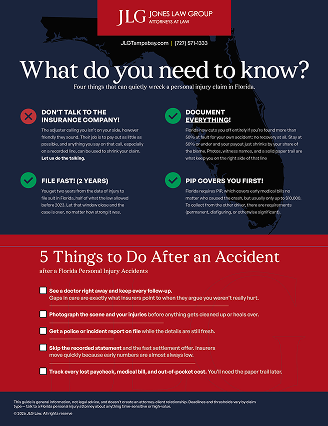
See the things you NEED TO DO after your accident. Get the 5 to-do's sent directly to your email.
