JONES LAW GROUPYour Lawyers for Life! Personal Injury Law Firm in St. Petersburg

The first 48 hours after a Florida slip and fall shape the entire case. Report the fall, photograph the hazard before it’s cleaned up, get witness contacts, see a doctor the same day, and do not give a recorded statement to the insurance company. This guide walks through the 10 steps that protect your claim, the mistakes that sink cases, and why Florida’s notice rule under § 768.0755 sinks more slip and fall cases than the injury itself.
Call our personal injury law office directly at (727) 512-9847
At Jones Law Group in St. Petersburg, FL, we would like to hear from you. Contact us for a free personal injury case consultation.
Call our personal injury law office at (727) 512-9847
Get educated on the Florida's personal injury laws and more.
By Bobby Jones, Esq. | Published June 16, 2026
If you slipped and fell at a Florida business, the most important steps are these: report the fall to a manager and request an incident report, photograph the hazard and surroundings before anything is cleaned up, get the names and phone numbers of any witnesses, seek medical attention the same day, do not give a recorded statement to the insurance company, and contact a Florida personal injury attorney before the two-year statute of limitations clock runs out. The decisions you make in the first 48 hours often shape the outcome of the entire claim.
This guide walks through exactly what to do, what to avoid, and what Florida law requires you to prove. If you were hurt in a fall at a grocery store, hotel, restaurant, or any other business in Florida, call Bobby Jones at (727) 571-1333 for a free consultation. No fee unless we win.
Follow these steps in order if you are physically able. If you cannot move or you suspect a serious injury, skip directly to step 5 and call 911.
Do not jump up out of embarrassment. The instinct to brush yourself off and walk away is the single biggest reason serious slip and fall injuries go undocumented. Sit or lie still for a minute. Check whether you can move each limb. Look for sharp pain, dizziness, or numbness. If anything feels wrong, stay down and ask someone to call for help.
If you do get up, do it slowly. Many slip and fall injuries, especially soft tissue and back injuries, present symptoms hours or days later as adrenaline wears off.
Ask to speak to the store manager or property manager on duty. Tell them you fell and that you want an incident report created. Most Florida businesses, especially national chains like Publix, Walmart, Target, and major hotels, have internal incident reporting procedures.
Get the manager’s full name and title. If they fill out a written report, ask for a copy. If they refuse to give you a copy, that is fine, but document who you spoke with and when. The report itself becomes evidence later, and the existence of the report locks the business into a contemporaneous record of what happened.
Do not exaggerate. Do not minimize either. Stick to what happened: where you fell, what caused the fall, and what hurts.
This is the single most valuable thing you can do for your case. Florida slip and fall law (specifically § 768.0755) requires you to prove the business knew or should have known about the hazard. Photographs of the actual condition at the moment of your fall are gold.
Take photos of:
If the business tries to clean up the spill while you are still there, ask them to wait until you have photographs. They may refuse. Take the photos as fast as you can either way.
Anyone who saw the fall, saw the hazard before the fall, or saw an employee walk past the hazard is a potential witness. Get full names and phone numbers. If they will not give you their phone number, ask for an email address.
Witnesses disappear fast. By the time an attorney is involved a week later, the customer who saw a Publix employee walk right past the puddle is long gone, and the store cannot or will not identify them. The two minutes you spend at the scene collecting contacts can be the difference between proving notice and losing the case.
Even if you feel “mostly okay,” go to an urgent care, emergency room, or your primary care physician on the same day as the fall. Two reasons.
First, slip and fall injuries often present late. Back injuries, soft tissue tears, and concussions frequently feel manageable for the first 24 to 72 hours and then become severely painful. Early documentation creates a medical record that ties the symptoms to the fall.
Second, gaps in treatment are the single most common argument insurance adjusters use to reduce or deny claims. “If you were really hurt, why did you wait three weeks to see a doctor?” is a question with no good answer. Same-day treatment removes that line of attack.
Tell the medical provider exactly how the fall happened and exactly what hurts. Be specific. “I slipped on a clear liquid at the Walmart on 34th Street and landed on my left hip and lower back. I have sharp pain on the left side and numbness down my left leg.” That kind of specificity ends up in the medical record and supports causation later.
Put them in a bag and do not wear them again. Insurance defense lawyers love to argue that inappropriate footwear caused the fall. The actual shoes you were wearing, intact and uncleaned, defeat that argument when they show normal tread and no defects. If you wear them to work the next day, that argument gets harder to defeat.
Within 24 to 72 hours of the fall, you will likely get a call from a claims adjuster representing the property’s insurer. They will sound friendly. They will say they just need to “get your side of the story” or “make sure they have all the facts.” They will ask to record the call.
Say no. Politely, firmly, and consistently. You are not required to give a recorded statement to the other party’s insurance company. Recorded statements are taken specifically to lock you into a version of events before you have all the medical information or legal advice. Adjusters are trained to ask questions designed to produce answers that hurt your case.
If you have already given a recorded statement, do not panic. Tell an attorney exactly what you said. The damage is often manageable, but it is harder to undo than it is to avoid in the first place.
Defense lawyers and insurance adjusters look at social media accounts in slip and fall cases. A photo of you smiling at a family barbecue two weeks after the fall becomes Exhibit A for the argument that you were not really hurt. A post about going to the gym becomes proof you can lift normally.
Lock down your privacy settings. Better, take a social media pause until the case resolves. Do not delete old posts, that can be considered destruction of evidence, but stop posting new ones.
Start a simple log the day of the fall. Date, pain level (0 to 10), what you could not do that day, what medications you took, any medical appointments. Keep this updated for the duration of treatment. Months later, when an adjuster or jury needs to understand what your daily life looked like during recovery, the journal is contemporaneous evidence that beats memory every time.
Surveillance footage at most Florida businesses is overwritten on a 30 to 90 day loop. Witness memories fade. Hazard conditions get fixed and forgotten. Many critical pieces of evidence in a slip and fall case have a shelf life measured in weeks, and a formal preservation letter from an attorney is what stops them from disappearing.
An early attorney consultation costs nothing. Most Florida injury attorneys, including Jones Law Group, work on contingency. No fee unless we win.
Three statutes shape almost every Florida slip and fall claim. Understanding them is how you understand which steps above matter most.
Under § 768.0755, if you slip on a “transitory foreign substance” at a business establishment, you must prove the business had actual or constructive knowledge of the dangerous condition and failed to fix it.
Actual knowledge means an employee or manager knew about the hazard. Maybe a customer reported it. Maybe surveillance shows a worker walking past it. Maybe the spill came from an employee dropping something.
Constructive knowledge means the condition existed long enough that the business should have caught it with reasonable inspection, or the type of hazard occurred regularly enough that the business should have anticipated it. Constructive notice is usually proved with circumstantial evidence: track marks through the liquid, drying around the edges, dirt or footprints in the substance, melting ice cream, or condensation patterns.
This is why immediate photographs matter so much. A clean photograph of a puddle with shopping cart tracks running through it is constructive notice evidence. A photograph taken three days later, after the spill has been cleaned and the floor reset, is not.
HB 837, signed by Governor DeSantis on March 24, 2023, cut the statute of limitations for most negligence-based personal injury claims from four years to two years. The change applies to any slip and fall on or after that date.
If you fell at a Florida business on June 1, 2024, you have until June 1, 2026 to file a lawsuit. After that date, the court will dismiss your case regardless of how strong the evidence is. The deadline is jurisdictional, which means no judge has discretion to extend it. We covered the deadline in detail in our 2026 statute of limitations guide.
Florida used to follow pure comparative negligence, where you could recover damages even if you were mostly at fault. HB 837 replaced that with the 51% bar: if a jury finds you more than 50% at fault for your own fall, you recover nothing.
Insurance defense lawyers push fault back onto plaintiffs aggressively in slip and fall cases. “You should have seen the wet floor sign.” “You were on your phone.” “Those flip-flops were inappropriate for the surface.” Under HB 837, those arguments are not just damage-reducing, they are potentially case-killing. Building a clean liability narrative through evidence, photos, and witness statements is more important than it used to be.
The mistakes below show up over and over in cases that arrive at our office in worse shape than they should be.
Do not leave without reporting. Leaving the property without telling a manager makes it dramatically harder to prove the fall happened where and how you say it did. The store has no record. There is no incident report. The defense can argue the fall happened somewhere else, or did not happen at all.
Do not refuse medical care because you “feel fine.” Adrenaline masks injuries. Same-day medical attention is documentation, not just treatment.
Do not give a recorded statement to the other side’s insurance. Politely decline until you have spoken to an attorney.
Do not accept a quick settlement offer. Insurance companies sometimes offer a few thousand dollars within days of a fall, before the full medical picture is clear. These quick offers are almost always far below what the case is worth. Once you sign a release, the case is over. We covered settlement valuation in our guide to Florida slip and fall settlement amounts.
Do not post on social media. Anything you post can and will be used against you.
Do not wait months to contact an attorney. Evidence disappears on a schedule that does not care about your recovery timeline.
Do not assume you have plenty of time. The two-year window closes faster than it sounds, especially when serious injuries require ongoing treatment before a case can be properly valued.
Pinellas County slip and fall cases tend to fall into a few specific patterns. Grocery store falls at the Publix, Walmart, and Target locations across St. Pete, Largo, and Clearwater are a steady volume. Pool deck and lobby falls at the beach hotels along Gulf Boulevard generate hotel premises cases. Restaurant falls, especially at busy waterfront establishments, come up regularly. Parking garage falls at the medical complexes near Bayfront Health St. Petersburg and Northside Hospital, and at the larger shopping centers, are common.
Local specifics matter. Pinellas County juries tend to land in a moderate range, neither as plaintiff-friendly as some South Florida venues nor as defense-tilted as some rural counties. Hotels along Gulf Boulevard carry meaningful commercial liability coverage but retain experienced defense counsel who fight notice arguments hard. National grocery chains have sophisticated risk management departments that begin building a defense the day of the fall, which is one more reason getting an attorney involved fast matters.
Bobby Jones is a Stetson Law graduate, an Air Force veteran, and has practiced personal injury law in Tampa Bay for more than 20 years. Jones Law Group has recovered more than $50 million for clients. Our office at 5622 Central Avenue, St. Petersburg, FL 33707 handles slip and fall cases throughout Pinellas County, Tampa, Clearwater, Largo, and across Florida.
For any fall on or after March 24, 2023, the deadline is two years from the date of the fall under Florida Statute § 95.11 as amended by HB 837. Falls before that date are governed by the old four-year rule. The deadline is jurisdictional, meaning the court has no discretion to extend it.
You are not entitled to a copy of an internal incident report at the time of the fall, but you can still document the report’s existence. Write down the manager’s name, title, the time, and that an incident report was created. Your attorney can request the report in discovery later if the case becomes a lawsuit.
Not usually. Police generally do not respond to slip and fall accidents at private businesses unless there is a serious medical emergency or a crime is involved. Your priorities are reporting to the business manager, documenting the scene, and getting medical care. If injuries are severe, call 911 for medical response.
No. You are not required to give a recorded or written statement to the other party’s insurance company. Politely decline and refer them to your attorney. You may be required to give a statement to your own insurance company under your policy’s cooperation clause, but that is a separate question.
You still have a case, but it becomes harder to prove. As soon as you realize you are injured, go back and report the fall, ask for an incident report, and document the scene if the hazard is still there. Then seek medical care immediately and contact an attorney. The longer the gap between the fall and the report, the more aggressively the defense will argue the fall did not happen as described.
Possibly. A wet floor sign does not automatically defeat a slip and fall claim under Florida law. The question is whether the sign was visible, placed close enough to the actual hazard, and adequate to warn of the specific danger. A wet floor sign in a different aisle does not warn about a spill in produce. A sign placed after the fall does not warn about anything.
Footwear is a comparative fault argument, not an automatic case-killer. The defense will argue that inappropriate footwear contributed to the fall. The strength of that argument depends on the type of business, the surface, and the warnings in place. Under HB 837’s 51% bar, footwear arguments are more dangerous than they used to be, but most reasonable footwear choices do not push a plaintiff over the 50% line on their own.
Straightforward cases with clear liability and modest injuries often resolve in six to twelve months. Cases involving disputed notice, multiple defendants, serious injuries requiring extended treatment, or trial preparation regularly take 18 to 24 months or longer. The two-year statute of limitations creates pressure to either settle or file suit before the deadline expires.
For minor injuries with clear liability and quick recovery, you may be able to handle the claim yourself. For any case involving surgery, lasting symptoms, disputed liability, or significant medical bills, having a Florida personal injury attorney is the difference between a fair settlement and a lowball offer. Most Florida injury attorneys work on contingency, so the initial consultation costs nothing and there is no fee unless the case wins.
The hardest cases we see are the ones that arrive at our office three months after the fall. The surveillance footage has been overwritten. The witnesses cannot be located. The incident report has been “lost.” The hazard has been fixed and forgotten. We can still work many of these cases, but every week that passes makes the road harder.
If you fell at a Florida business, in a Publix in St. Pete, a hotel in Clearwater, a parking garage in Tampa, or anywhere else, talk to a Florida personal injury attorney while the evidence is still fresh. Bobby Jones and the team at Jones Law Group have recovered more than $50 million for injured Floridians. The consultation is free, and there is no fee unless we win.
Call (727) 571-1333 or email [email protected].
This article is for general informational purposes only and is not legal advice. Reading it does not create an attorney-client relationship with Jones Law Group. Every case is different, and past results do not guarantee a similar outcome in any future case. For advice about your specific situation, contact a licensed Florida personal injury attorney.

Lane splitting is the action in which motorcyclists will occupy the space between two cars in order to pass. Lane splitting is often utilized by motorcyclists in stop-and-go traffic and allows them to escape congested areas. Arguments are made that by utilizing lane splitting, motorcyclists are helping to cut down on the amount of pollution […]

The world has changed greatly because of COVID-19. With the United States in lockdown for months on end and mask mandates required almost everywhere, many people are staying in their homes even past the end of lockdown to prevent themselves (and protect others) from getting COVID-19. 169 million people in the United States have received […]

By: Heath C. Murphy + – Personal Injury There is no hard fast rule for what clothing should be worn when riding a motorcycle. It is certainly not against the law to ride with no helmet, no shirt, board shorts and flip flops. Just because it’s not against the law does not mean it is […]

Pedestrian Safety Issues in St. Petersburg St. Petersburg is a city in which there are a lot of pedestrians. We are blessed with an urban environment in which walking is practical and convenient. Pinellas County is also home to miles of pristine beaches that are lined by hundreds of resorts and hotels. This tourist haven […]

Summary When you’re involved in an accident, the aftermath can be overwhelming and stressful. Knowing how to talk to insurance companies effectively to protect your rights and ensure fair compensation for your injuries and damages is crucial. The personal injury attorneys with Jones Law Group would like to share some information on how to talk […]

It won’t take long before the at-fault driver’s insurance company sends an adjuster to get you to agree to a settlement. This skilled professional might act like they’re your friend and want to help, but they’ll be anything but friendly. Insurance adjusters will try to trick you into making a mistake that could damage your […]
Speak with us before time runs out! In Florida, you have a limited window to file a personal injury case, so speak to an Attorney today.
Call our personal injury law office directly at (727) 512-9847

Jones Law Group is a dedicated personal injury lawyer in St. Petersburg, FL, serving the Tampa Bay area since 2006. Our experienced attorneys specialize in car accidents, slip and fall cases, employment law disputes, construction law issues, and overtime wage claims, fighting for maximum compensation on a contingency fee basis. Contact us for a free consultation to discuss your case.
Call our personal injury law office at (727) 512-9847
© Copyright 2006–2025 Jones Law Group Attorneys at Law. All rights reserved. Privacy Policy Terms of Use
Attorney Advertising.
The information on this website is for general information purposes only. Nothing on this site should be taken as legal advice for any individual case or situation. This information is not intended to create, and receipt or viewing does not constitute, an attorney-client relationship. Past results do not guarantee similar outcomes.
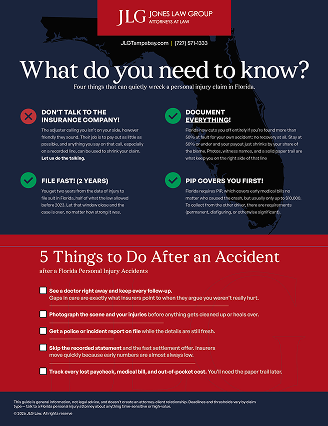
See the things you NEED TO DO after your accident. Get the 5 to-do's sent directly to your email.