JONES LAW GROUPYour Lawyers for Life! Personal Injury Law Firm in St. Petersburg
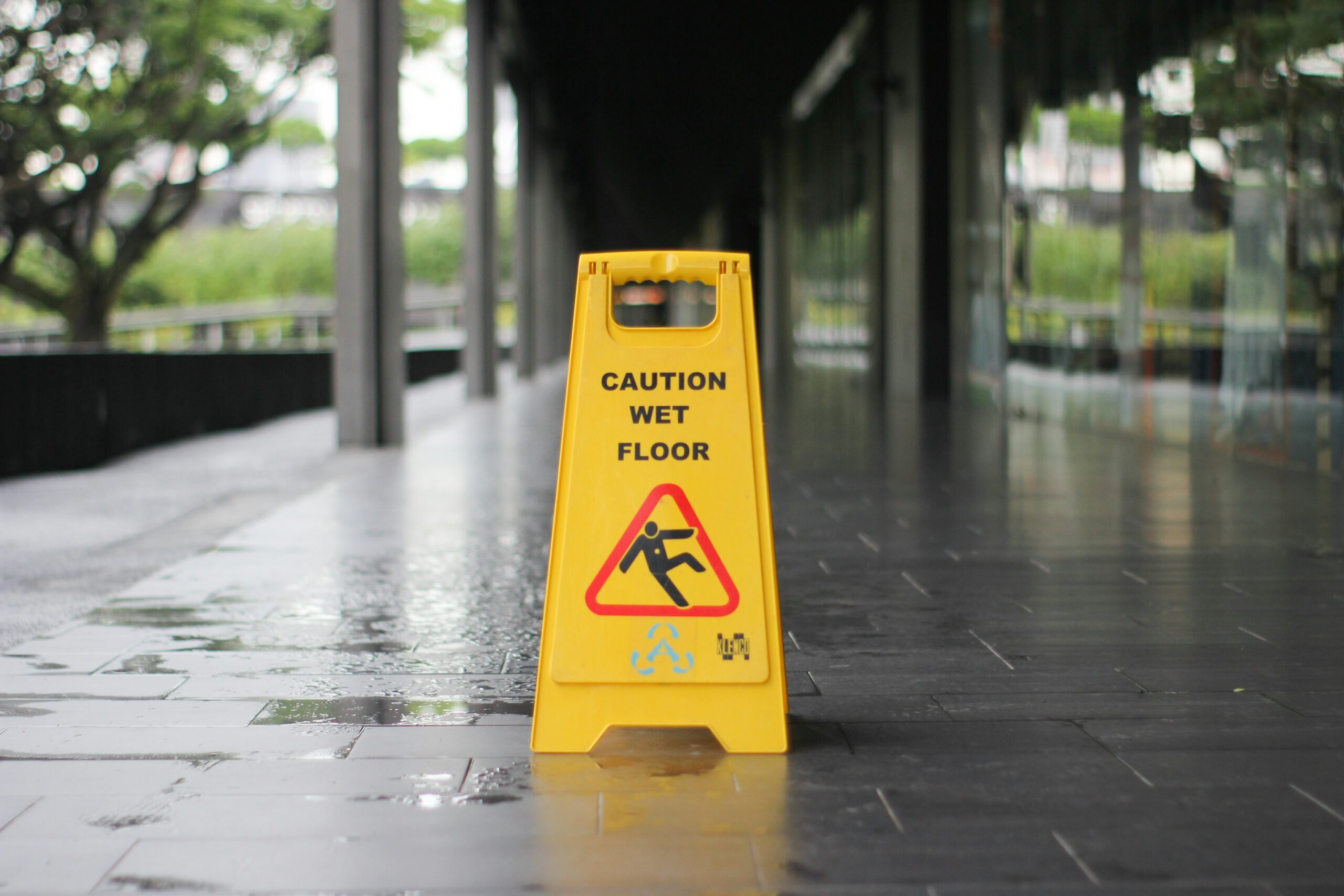
There’s no single “average” Florida slip and fall settlement. Cases range from $10,000 for soft tissue injuries to seven figures for surgical fusions and TBIs. What actually decides the number is a stack of specific factors: injury severity, surgery, the notice rule under § 768.0755, HB 837’s 51% bar on comparative fault, and insurance policy limits. This 2026 guide walks through real settlement ranges, what moves a case from the low end to the high end, and the first 48 hours of evidence that matter most.
Call our personal injury law office directly at (727) 512-9847
At Jones Law Group in St. Petersburg, FL, we would like to hear from you. Contact us for a free personal injury case consultation.
Call our personal injury law office at (727) 512-9847
Get educated on the Florida's personal injury laws and more.
If you fell at a Publix in St. Petersburg, a hotel pool deck in Clearwater, or a parking garage in Tampa, the first question is almost always the same: what’s this case worth? The honest answer is that there’s no single “average.” Florida slip and fall settlements run from a few thousand dollars for a sprained wrist to seven figures for a fusion surgery. But there are real ranges, and there are specific factors that move a case from the low end to the high end of those ranges.
This guide walks through what Florida slip and fall settlements actually look like in 2026, what drives case value, where insurance companies push back hardest, and how HB 837 changed the math for these claims. If you were injured in a fall anywhere in Florida and want a straight answer about your case, call Bobby Jones at (727) 571-1333. The consultation is free, and there’s no fee unless we win.
Most published “average” numbers for Florida slip and fall cases land somewhere between $15,000 and $175,000. That range is enormous because it’s averaging across wildly different cases: a bruised hip in a grocery store and a herniated disc requiring lumbar fusion don’t belong in the same number. Practitioner data tends to cluster around these tiers:
Those ranges are useful as a sanity check, not a quote. Two cases with identical injuries can settle for very different numbers depending on the liability story, the venue, the insurance policy limits, and how the medical evidence is presented. A fall on a wet floor at a national grocery chain with a high-limit policy is a different case than the same fall in a small mom-and-pop shop with minimum coverage, even if the injuries are identical.
The single biggest swing factor isn’t the fall itself. It’s whether the injury required surgery, whether it left a permanent impairment, and whether the medical records cleanly tie the injury to the fall. Those are the levers that move a slip and fall case from a five-figure settlement to a six-figure one.
Florida’s 2023 tort reform law, HB 837, reshaped premises liability claims in ways that still surprise people three years later. Two changes matter most for slip and fall cases.
For any slip and fall that happened on or after March 24, 2023, you now have two years from the date of the fall to file a lawsuit. That’s down from four years under the old rule. Falls that happened before March 24, 2023 still get the old four-year deadline. Once that window closes, your case is done, regardless of how strong the evidence is. We covered the deadline mechanics in detail in our 2026 guide to Florida’s statute of limitations.
Florida used to follow pure comparative negligence, meaning you could recover something even if you were mostly to blame. HB 837 replaced that with modified comparative negligence. If a jury finds you more than 50% at fault for your own fall, you recover nothing.
This matters in slip and fall cases more than almost any other category, because defendants in premises cases love to argue fault back onto the plaintiff. “You should have seen the wet floor sign.” “You were on your phone.” “Those shoes were inappropriate for that surface.” Every one of those arguments is now potentially case-killing, not just case-reducing. Building a clean liability story early is more important than it used to be.
The dollar figure on a settlement check is built from a stack of specific factors. Here’s how each one moves the number.
This is the biggest single driver of case value. A soft tissue strain that resolves in eight weeks of physical therapy will settle in a fundamentally different range than a herniated disc that required a fusion. Surgery is more than a medical event in a slip and fall claim. It’s documentary proof to an adjuster or a jury that the injury was real, serious, and lasting. Shoulder repairs, knee reconstructions, lumbar fusions, and cervical fusions all push cases toward six- and seven-figure territory when liability is clean.
If a treating physician assigns a permanent impairment rating, the case value climbs. Permanent doesn’t have to mean wheelchair-bound. It can mean ongoing range-of-motion limits, chronic pain, or a documented restriction on lifting or standing. Those ratings give an attorney something concrete to put in front of an insurer.
Economic damages, the hard numbers, anchor the case. Past medical bills are usually documented to the dollar. Future medical costs, projected through life care plans or treating physician estimates, can be substantial, especially when ongoing pain management, future surgery, or assistive devices are in play. HB 837 changed the rules on what billing amounts can be presented to a jury, pushing toward amounts actually paid rather than sticker-price billing, which has compressed some case values.
If the fall kept you out of work, those wages get added to the demand. If it permanently affected your ability to do your job, that’s lost earning capacity, often a much larger number than the missed paychecks themselves. A 45-year-old construction worker with a back injury that prevents heavy lifting has a different earning capacity claim than a desk-bound professional with the same injury.
Non-economic damages cover the parts of the loss that don’t show up on a bill: physical pain, emotional distress, loss of enjoyment of life, sleep disruption, anxiety, depression tied to the injury. Florida attorneys typically estimate this using a multiplier, somewhere between 1.5 and 5 times the economic damages, scaled to severity and permanence. The multiplier method is a negotiating heuristic, not a statutory formula. A jury can land wherever the evidence supports.
Under HB 837’s 51% bar, any percentage of fault assigned to you under 51% reduces your recovery proportionally. If your damages add up to $200,000 and you’re found 25% at fault, you recover $150,000. If you’re found 51% at fault, you recover zero. Insurers know this and aggressively push fault percentages up during negotiation.
You can’t collect more than what’s available. A small business with a $300,000 liability policy is a different settlement environment than a national chain with multi-million-dollar coverage. Identifying every available policy, including umbrella coverage, is part of building case value.
Where the case would be tried matters. South Florida jurisdictions tend to produce higher verdicts than rural counties. Pinellas County, where most of our St. Pete, Largo, and Clearwater cases land, sits in a moderate range. The jury pool a case is heading toward affects settlement leverage even when the case never reaches trial.
Here’s the rule that decides more Florida slip and fall cases than injury severity ever does: Florida Statute § 768.0755, the transitory foreign substance statute.
If you slipped on a substance in a business, you don’t just have to prove the substance was there. You have to prove the business knew or should have known about it and failed to fix it. This is called the notice requirement, and it’s the leading reason slip and fall cases get dismissed before they ever reach a jury.
Notice can be proven two ways:
Constructive notice usually comes down to circumstantial evidence: cart track marks through the liquid, dirt or footprints in it, drying around the edges, melted ice cream, condensation patterns. Florida courts have been clear that just showing a slippery substance existed isn’t enough. You have to show it was there long enough that the store should have caught it.
This is why evidence gathered in the first 24 hours after a fall is so valuable. Photos of the spill, the surrounding area, footprints or track marks, lighting conditions, and any warning signs (or lack thereof) can be the difference between a viable case and a dismissed one. Surveillance footage typically gets overwritten on a 30- to 90-day loop, so getting an attorney involved fast often means getting a preservation letter out before the video disappears.
Here’s how different slip and fall injuries tend to land in Florida, assuming clean liability and adequate insurance coverage.
Strains, sprains, contusions, and minor whiplash typically settle in the $10,000 to $30,000 range when supported by conservative treatment and short-term physical therapy. These cases get hit hardest by adjusters arguing that the injury was minor and would have resolved on its own.
A broken wrist, ankle, or forearm that heals with casting but no surgery often lands between $25,000 and $75,000. The fact pattern and lost work time matter a lot here.
Open reduction with internal fixation, hardware placement, or any surgical intervention for a broken bone significantly increases value. Hip fractures in older adults, common in slip and falls, regularly settle in the $100,000 to $400,000+ range, especially when they involve replacement surgery or ongoing mobility limits.
A herniated disc treated conservatively, including injections and physical therapy, typically settles between $40,000 and $150,000, depending on permanence and how clearly the imaging ties to the fall.
Once a fusion, discectomy, or laminectomy enters the picture, settlements regularly climb into the $250,000 to $1 million+ range. Cervical and lumbar fusions, especially multi-level, are the cases where seven-figure outcomes happen.
Even “mild” TBIs with documented cognitive deficits push case value well above five figures. Moderate to severe TBI cases, with documented imaging findings, cognitive testing deficits, and permanent impairment, can settle for $500,000 to several million dollars.
Spinal cord injuries, amputations, and permanent paralysis from a fall, while rare, represent the high end of the range. Multi-million-dollar settlements and verdicts in this category are documented across Florida every year.
None of these ranges are promises. They’re patterns. The specific number depends on every factor laid out above plus the things that don’t fit neatly into a list: how credible the plaintiff comes across, how the defendant’s witnesses hold up, what a particular adjuster’s authority is, and a hundred other variables that experienced injury attorneys learn to read.
Pinellas County has a specific set of slip and fall patterns. Heavy tourist foot traffic on Gulf Boulevard hotels and beachfront restaurants generates wet-surface cases on pool decks, lobby tiles, and outdoor dining areas. Grocery store falls at the Publix locations across St. Pete, Largo, and Clearwater are a steady stream. Parking garage falls, especially at the medical complexes near Bayfront and Northside Hospital, come up regularly. The Pinellas Trail and downtown St. Pete sidewalks generate trip-and-fall cases on uneven pavement and raised expansion joints.
Hotels are a category of their own. Pool deck slips, bathroom falls, and lobby tile incidents at the major beach hotels involve commercial general liability policies that often have meaningful limits, but defense counsel for hotel chains is sophisticated and fights notice arguments hard. Hotel cases reward early investigation more than almost any other category.
The Pinellas County courts produce moderate verdict ranges, neither as plaintiff-friendly as some South Florida venues nor as defense-tilted as some rural counties. Cases that settle pre-suit tend to land closer to the case’s straight-line valuation, while cases that have to be filed and worked through discovery can move in either direction.
Bobby Jones has practiced personal injury law in Tampa Bay for more than 20 years and has recovered over $50 million for clients. The Jones Law Group office at 5622 Central Avenue in St. Petersburg handles slip and fall cases throughout Pinellas County, Tampa, Clearwater, Largo, and across Florida.
The first 48 hours matter more than people realize. The case you build in those two days shapes the settlement number months later.
There’s no single average, but most Florida slip and fall settlements fall somewhere between $15,000 and $175,000, with serious surgical cases climbing into six and seven figures. Injury severity, surgery, permanence, comparative fault, and insurance limits are the biggest drivers.
For falls on or after March 24, 2023, the deadline is two years from the date of the fall under Florida Statute § 95.11, as amended by HB 837. Falls before that date are governed by the old four-year rule.
Under Florida’s modified comparative negligence rule, you can still recover damages as long as you’re 50% or less at fault. Your recovery is reduced by your percentage of fault. If you’re found more than 50% at fault, you recover nothing.
Under Florida Statute § 768.0755, you have to prove the business had actual or constructive knowledge of the dangerous condition. Constructive knowledge is shown either by how long the hazard existed or by evidence that the condition occurred regularly. This notice requirement is the leading reason slip and fall cases get dismissed.
Straightforward cases can settle in six to twelve months. Cases involving disputed liability, multiple defendants, or significant injuries requiring ongoing treatment often take 18 to 24 months or longer. The two-year statute of limitations creates real pressure to either resolve the case or file suit before the deadline.
Sometimes. A wet floor sign doesn’t automatically defeat a slip and fall claim. The question is whether the sign was visible, placed in a reasonable location, and adequate to warn of the actual hazard. A wet floor sign in the middle of a different aisle does not warn about a spill in the produce section.
Hotels and restaurants are business establishments subject to the same notice requirements under § 768.0755. They tend to carry higher liability limits than smaller businesses but also retain more aggressive defense counsel. Pool deck, bathroom, and lobby falls are common case types.
The “average” number you find online is useful for a ballpark, but no online range can value your specific case. The injury, the liability story, the notice evidence, the insurance limits, and the venue all combine into a real number that takes an experienced attorney to estimate accurately. And the longer you wait, the more evidence disappears.
If you fell anywhere in Florida, in a Publix in St. Pete, a hotel in Clearwater, a parking garage in Tampa, or anywhere else, Bobby Jones and the team at Jones Law Group will give you a straight answer on what your case is worth. The consultation is free. There’s no fee unless we win.
Call (727) 571-1333 or email [email protected].
This article is for general informational purposes only and is not legal advice. Reading it does not create an attorney-client relationship with Jones Law Group. Every case is different, and past results do not guarantee a similar outcome in any future case. For advice about your specific situation, contact a licensed Florida personal injury attorney.

Summary If you were recently involved in a personal injury accident, you might be wondering if you’re wholly or partially responsible. The aftermath of a car wreck, slip and fall, or any other accident can be confusing. You might not be sure if you played a role in causing the accident. This question is crucial […]

Injuries and deaths caused by motorcycle accidents in Florida are all too common. With Florida’s ideal climate for outdoor activities, motorists need to be more cautious and less distracted when driving in Florida and always be aware of motorcycles on the road. Speed is also a factor in many motorcycle accidents. Florida leads the nation […]
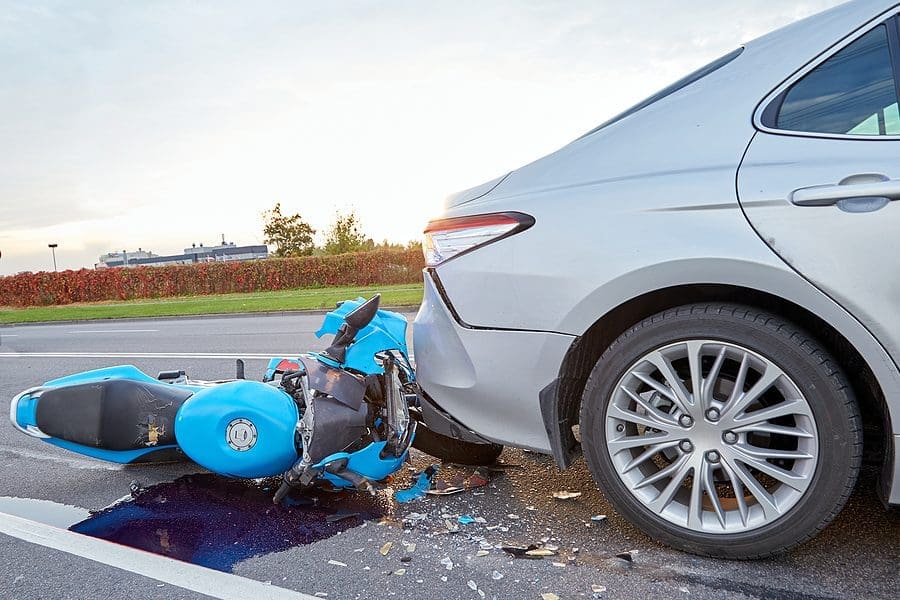
A study by Consumer Reports found that the average midsized sedan has a blind spot of 13 feet for an average-height driver (5’8). For an average-sized Sports Utility Vehicle (SUV), there is a blind spot of 18 feet for an average-height driver. The amount of distance in a car’s blind spot is even larger for […]

By: Heath C. Murphy + – Personal Injury Motorcyclists have a reputation as dangerous risk takers. However, according to a study that examined the causes of Florida motorcycle accidents over a period of 10 years, the motorists driving cars are usually to blame when a collision takes place. More than 60% of the time when […]

Many people are involved in car, motorcycle, bicycle or pedestrian accidents from which they walk away without broken bones or major lacerations. They might get treated and quickly released from the emergency room with standard orders of rest and over the counter pain medications or they might not seek medical assistance at all. They will […]
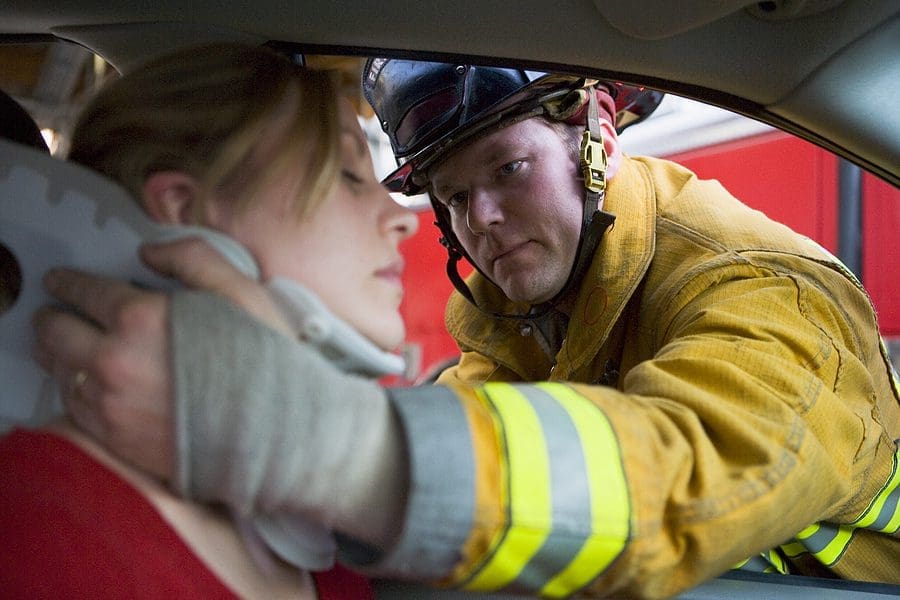
While in theory any part of the body is vulnerable to harm in a crash, some car accident injuries are more common than others. Summary Any accident involving a motor vehicle can result in catastrophic injuries. A commercial truck could crush the top of a car. A motorcyclist could be thrown from their bike after […]
Speak with us before time runs out! In Florida, you have a limited window to file a personal injury case, so speak to an Attorney today.
Call our personal injury law office directly at (727) 512-9847

Jones Law Group is a dedicated personal injury lawyer in St. Petersburg, FL, serving the Tampa Bay area since 2006. Our experienced attorneys specialize in car accidents, slip and fall cases, employment law disputes, construction law issues, and overtime wage claims, fighting for maximum compensation on a contingency fee basis. Contact us for a free consultation to discuss your case.
Call our personal injury law office at (727) 512-9847
© Copyright 2006–2025 Jones Law Group Attorneys at Law. All rights reserved. Privacy Policy Terms of Use
Attorney Advertising.
The information on this website is for general information purposes only. Nothing on this site should be taken as legal advice for any individual case or situation. This information is not intended to create, and receipt or viewing does not constitute, an attorney-client relationship. Past results do not guarantee similar outcomes.
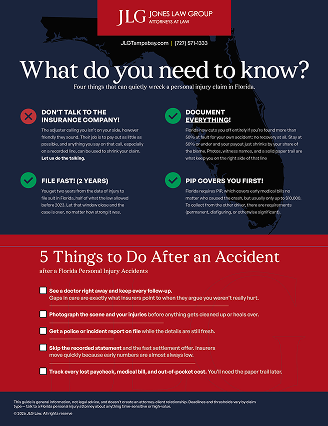
See the things you NEED TO DO after your accident. Get the 5 to-do's sent directly to your email.